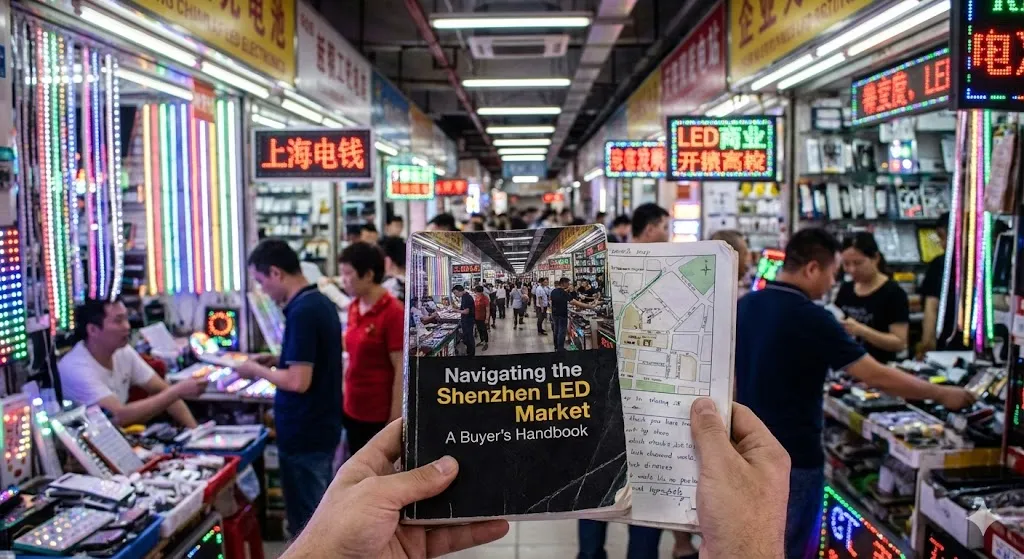
"Sourcing LED lights from China is not mainly about finding the cheapest quote. It is about finding the supplier that can hold quality, communication, and delivery when the order becomes real."
Why buyers choose China for LED lighting
China remains the strongest sourcing base for LED lighting because the ecosystem is dense. Chips, drivers, housings, optics, finishing, packaging, and testing resources are close together, which gives buyers more choice and faster iteration.
But that same density creates noise. A beautiful catalog does not guarantee engineering depth, stable quality control, or real production ownership. That is where most sourcing mistakes begin.
Step 1: Start with the right supplier type
- Factory: Better when you need technical consistency, OEM work, and long-term product development.
- Trading company: Sometimes useful for mixed purchasing, but often weaker on deep technical control.
- Sourcing partner: Useful when you need cross-factory comparison, factory screening, quality follow-up, and buyer-side coordination.
If your project depends on architectural quality, custom packaging, or repeated orders, the best result often comes from a manufacturer plus sourcing-side quality control, not from a random low-price offer.
Step 2: Qualify the supplier before discussing price too deeply
- Check specialization. A supplier offering chandeliers, street lights, grow lights, and downlights all in one brochure is usually not a focused commercial lighting manufacturer.
- Ask what they actually produce in-house. Assembly, driver matching, aging, testing, packaging, and quality checkpoints matter more than website polish.
- Review certifications and test logic. CE, RoHS, ERP, UL, ETL, or project-specific compliance should align with your target market.
- Check communication quality early. Slow, vague, or inconsistent answers before sampling usually become worse during production.
Step 3: Use samples to test the supplier, not just the fixture
Many buyers evaluate only the sample appearance. That is incomplete. The sample stage should test whether the supplier can follow requirements accurately.
- Did they follow beam angle, CCT, CRI, and driver requirements correctly?
- Did they label the sample clearly and provide supporting data?
- Did they respond well to revisions and technical questions?
- Did they expose issues honestly or try to hide them?
Step 4: Reduce mass-production risk before paying the deposit
Before moving into volume orders, buyers should lock the basics:
- Approved sample record with photos and revision notes
- Confirmed specification sheet covering wattage, lumen level, beam angle, CCT, CRI, dimming, finish, and packaging
- Inspection checkpoints for incoming materials, assembly, aging, and final packaging
- Production timeline that includes sample approval, pilot run, mass production, and shipment handoff
The red flags buyers should not ignore
Prices that move too fast
If a supplier cuts price immediately without revisiting the specification, that usually means quality variables are not under control.
No structured QC process
If they cannot explain incoming inspection, aging, or final inspection clearly, quality risk is being passed to you.
Generic answers to technical questions
Commercial lighting projects need clarity on drivers, optics, thermal control, compliance, and packaging. Generic answers usually mean weak ownership.
A practical sourcing rule
Do not choose a supplier only because they won the quote sheet. Choose the supplier that can still perform after sampling, revision, quality checks, and delivery pressure. That is what protects margin, project timeline, and client trust.
Where to go next
- Explore sourcing support if you want factory screening, sample follow-up, and procurement coordination in China.
- Review OEM / ODM capabilities if you need custom branding, packaging, or product adaptation.
- Browse commercial lighting products if you are still comparing fixture categories and technical directions.
FAQ
Should buyers work directly with factories?
Often yes, especially for repeat orders and technical products. But direct factory relationships work best when the buyer also has strong quality checkpoints and clear communication.
Is the lowest MOQ usually the best sign?
Not necessarily. Very low MOQ flexibility can sometimes signal that the supplier is trading standard stock rather than controlling production depth.
What should a buyer request before placing a production order?
Request the approved sample reference, final specification sheet, production timing, quality checkpoints, and a clear description of what is tested before shipment.
Commercial Pathways