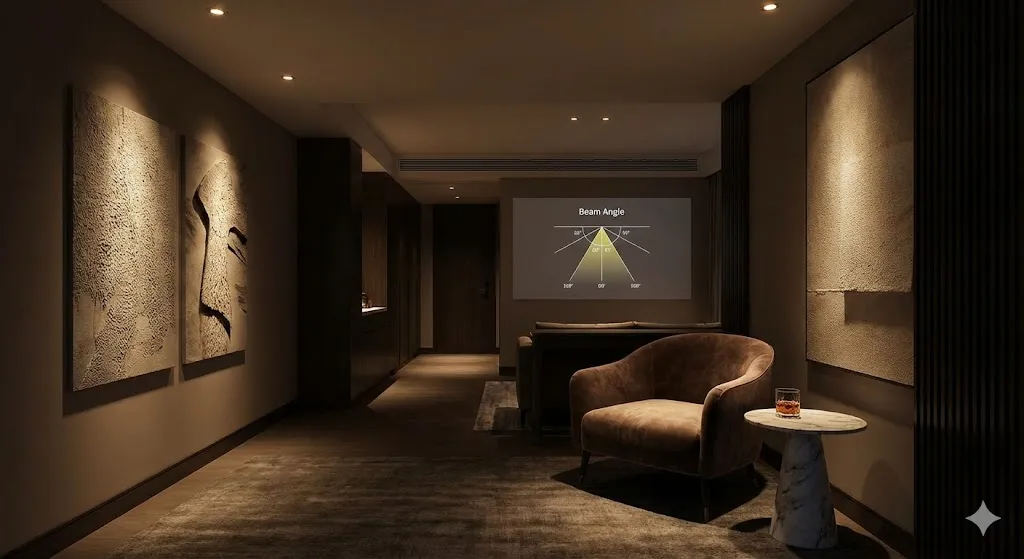
"A good fixture with the wrong beam angle still produces a bad result. In commercial lighting, beam control is not a detail. It is the visual strategy."
What beam angle actually means
Beam angle describes how widely light spreads from a fixture. A narrow beam concentrates light into a tighter cone, while a wide beam spreads the same output over a broader area.
For buyers and specifiers, the practical question is simple: Do you want focused contrast, comfortable general illumination, or wall coverage? The beam angle determines that outcome more than most people expect.
A fast way to read beam angles
- 10° to 24°: Accent lighting. Used to create drama, highlight products, and guide attention.
- 24° to 40°: The most common project range. Flexible enough for retail, hospitality, and selective general lighting.
- 40° to 60°: Broad distribution for comfortable ambient layers, circulation zones, and larger surfaces.
- 60°+: Wide flood or wash effect. Useful when uniformity matters more than contrast.
Where each beam angle works best
Retail and showroom projects
Retail environments often need a mix. Narrow beams help products stand out, while medium beams support aisle circulation and broader merchandise displays. If everything is wide, nothing feels premium. If everything is narrow, the store feels patchy and over-designed.
Hospitality and residential projects
Hotels, villas, and branded residences usually rely on medium beams for comfort, with selective narrow beams for art, headboards, feature walls, and decorative materials. The goal is layered atmosphere rather than uniform brightness.
Office and workplace lighting
Office lighting tends to prioritize uniformity, glare control, and visual comfort. Wider beams and linear optics often work better than narrow spot distributions unless the project has strong architectural focal zones.
The three mistakes buyers make most often
- Choosing beam angle from a catalog without ceiling height. The same 24° beam behaves very differently at 2.8 meters and 5 meters.
- Trying to solve every zone with one optic. Real projects often need multiple beam angles within the same family of fixtures.
- Ignoring glare and spacing. Beam angle, UGR, and fixture spacing must be reviewed together, not separately.
How to specify beam angle more intelligently
- Start with application and ceiling height, not just fixture wattage.
- Ask suppliers for IES files, spacing guidance, and real project mockups.
- Review beam angle together with CRI, CCT, glare control, and aiming flexibility.
- Where merchandise or architectural texture matters, test at least two optic options before final approval.
A practical buying rule
If a project depends on contrast, direction, mood, or product emphasis, treat beam angle as a core specification item. If the project only asks for generic brightness, you are leaving visual quality to chance.
Where to go next
- Browse commercial LED lighting products if you want to compare fixture categories with different optic options.
- Review lighting solutions by application if you are planning hospitality, office, retail, or residential projects.
- Talk to the Formore team if you want help matching beam angle to real project layouts.
FAQ
Is a narrower beam always better for premium projects?
No. Narrow beams are useful for emphasis, but a premium project still needs comfortable ambient layers. Most strong schemes combine narrow and medium optics rather than using one beam everywhere.
What is the safest beam angle for general commercial use?
There is no universal safe answer, but medium beams in the roughly 24° to 40° range are often the most flexible starting point for commercial interiors.
What should buyers request from suppliers?
Ask for beam options, photometric files, spacing recommendations, aiming advice, and project examples. That gives you a much better basis than a single catalog line.
Commercial Pathways