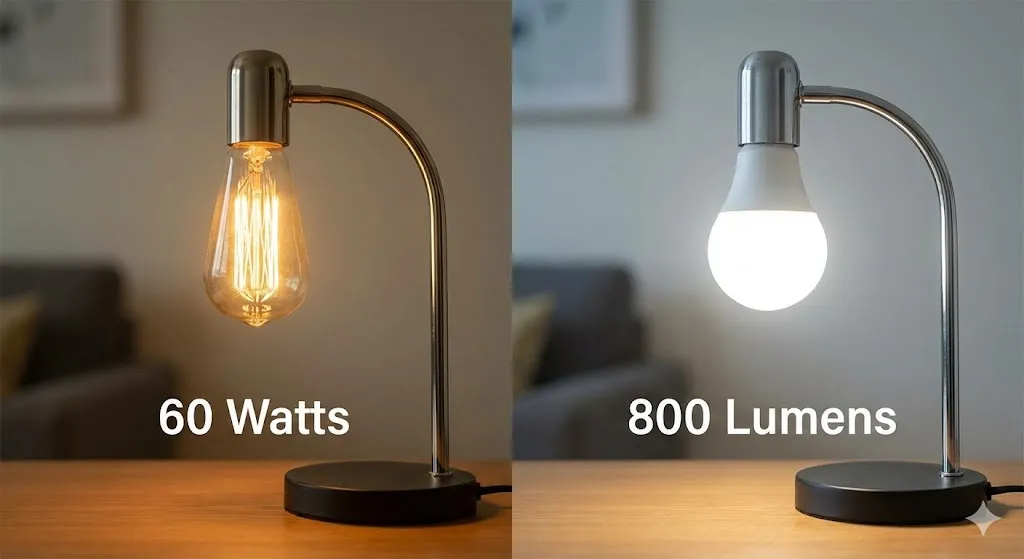
"Stop looking at watts. Learn why lumens are the only metric that matters for LED brightness and how to stop buying bulbs that are too dim."
The Watts Myth
Hook: Are you still buying light bulbs based on watts? You might be getting the wrong brightness.
The Short Answer:
- Lumens (lm) measure brightness (how much light is produced).
- Watts (W) measure energy consumption (how much power is used).
In the old days of incandescent bulbs, more watts meant more light. With LEDs, that rule is dead. A 9W LED can be brighter than a 60W incandescent. To get the light you want, ignore the watts and check the lumens.
The Technical Shift
Understanding the efficiency of LEDs requires looking at Luminous Efficacy, measured in lumens per watt (lm/W).
Quick Conversion Chart
Actionable Advice
When buying LEDs for your project, calculate the Total Lumens you need for the space, not the watts.
- Living Room: 1,500 - 3,000 lumens total.
- Kitchen: 4,000 - 8,000 lumens total (brightness needed for cooking).
- Bedroom: 2,000 - 4,000 lumens total.
Frequently Asked Questions
Q: "I bought a 9W LED and it seems dimmer than my old 60W. Why?"
A: Not all watts are created equal. Cheap LEDs have lower efficacy. That bargain bin 9W LED might only output 600 lumens, whereas a quality one outputs 900+.
Commercial Pathways