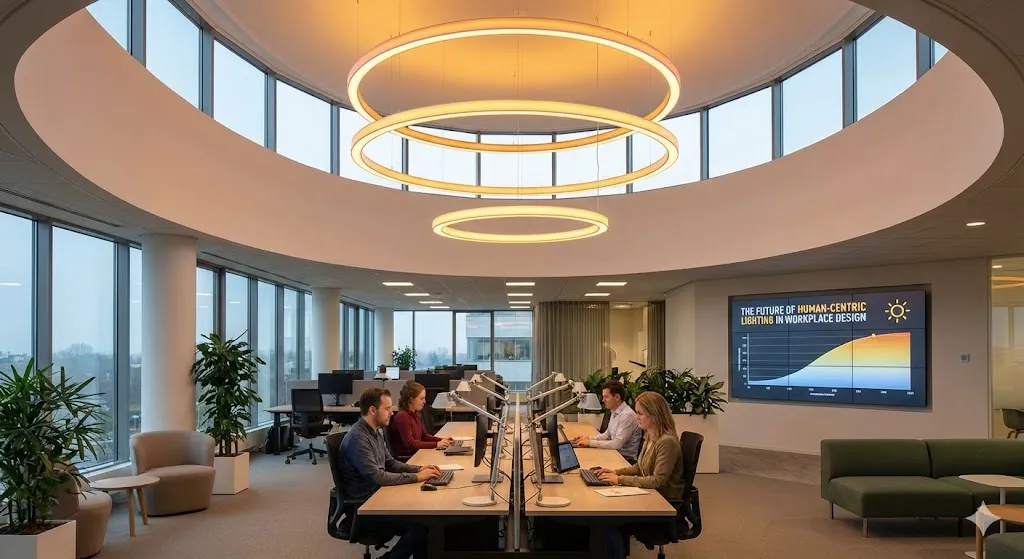
UGR is one of the fastest ways to tell whether an office luminaire will feel comfortable or harsh once it is installed above real desks.
What is UGR in office lighting?
UGR (Unified Glare Rating) estimates how much discomfort glare a lighting installation is likely to create for a viewer in a standardized room model. It is not a simple product sticker like wattage. It depends on the luminaire's luminance, luminous intensity distribution, mounting position, room reflectances, and observer position.
In practical buying terms, UGR answers a commercial question: Will this office light feel comfortable for people working under it all day?
According to the CIE glare framework used across the lighting industry, lower UGR values generally mean less discomfort. For specification work, many office projects also reference guidance aligned with IES recommended practices for indoor visual comfort.
Why does UGR <19 matter for workplaces?
For desk-intensive offices, meeting rooms, and open-plan floors, UGR <19 is a common procurement benchmark because it balances adequate illuminance with reduced glare.
| UGR band | Typical interpretation | Common use |
|---|---|---|
| <16 | Very low glare | High-focus task zones, premium offices |
| <19 | Low glare workplace target | General offices, classrooms |
| <22 | Moderate glare | Corridors, secondary areas |
| 22+ | Higher glare risk | Usually avoid for long desk work |
A fixture can be bright and efficient yet still fail in an office if unprotected high-luminance LEDs sit in the worker's field of view. That is why glare control belongs in the same conversation as lumen output, CCT, and CRI.
How should buyers evaluate UGR when sourcing LED lights?
- Ask for photometry, not slogans. Request IES or LDT files and a UGR table for realistic mounting heights.
- Confirm the calculation context. UGR changes with spacing-to-height ratio, room reflectances, and viewing direction.
- Inspect optical design. Deep-recessed optics, micro-prismatic panels, baffles, and well-shielded linear profiles usually perform better than exposed high-brightness dots.
- Balance glare with efficacy. Ultra-high lm/W claims mean little if the installation creates visual stress.
- Validate with samples. Review the product at the intended angle and mounting height before locking a bulk PO.
If you are comparing categories, start with our commercial LED lighting products. If you need factory-side help reviewing samples and photometric claims, use China lighting sourcing support. For private-label or customized optics, review OEM and ODM manufacturing.
What causes high UGR in real offices?
High UGR usually comes from a combination of exposed LED dots, shallow optics, glossy surfaces, and layouts that place bright apertures directly in the line of sight. Large open-plan rooms with dark ceilings can also make luminaires appear harsher because the contrast between the fixture and the background increases.
How do UGR, CRI, and CCT work together?
UGR controls comfort. CRI controls color fidelity. CCT controls atmosphere. An office can meet lux targets and still fail if glare is high, colors look dull, or the spectrum feels too cool for the culture of the workplace. Treat these as one specification package rather than isolated line items.
Authoritative references for specification teams include CIE publications on discomfort glare and IES indoor lighting practices. When a supplier cannot connect a UGR claim to photometric evidence, treat the claim as incomplete.
A practical buying rule for office projects
If people will sit under the lights for hours, make UGR <19 the default conversation starter, then confirm photometry, sample appearance, CRI, CCT, and maintenance access. Efficiency still matters, but comfort is what keeps an office installation from becoming a complaint ticket.