An LED flood light manufacturer builds high-output fixtures for sports fields, yards, facades, and industrial sites, where beam control, thermal design, and ingress protection decide whether a project succeeds. Buyers should define the application first, then lock beam angle, CCT, IP/IK rating, surge protection, and driver choice before requesting samples and photometric files.
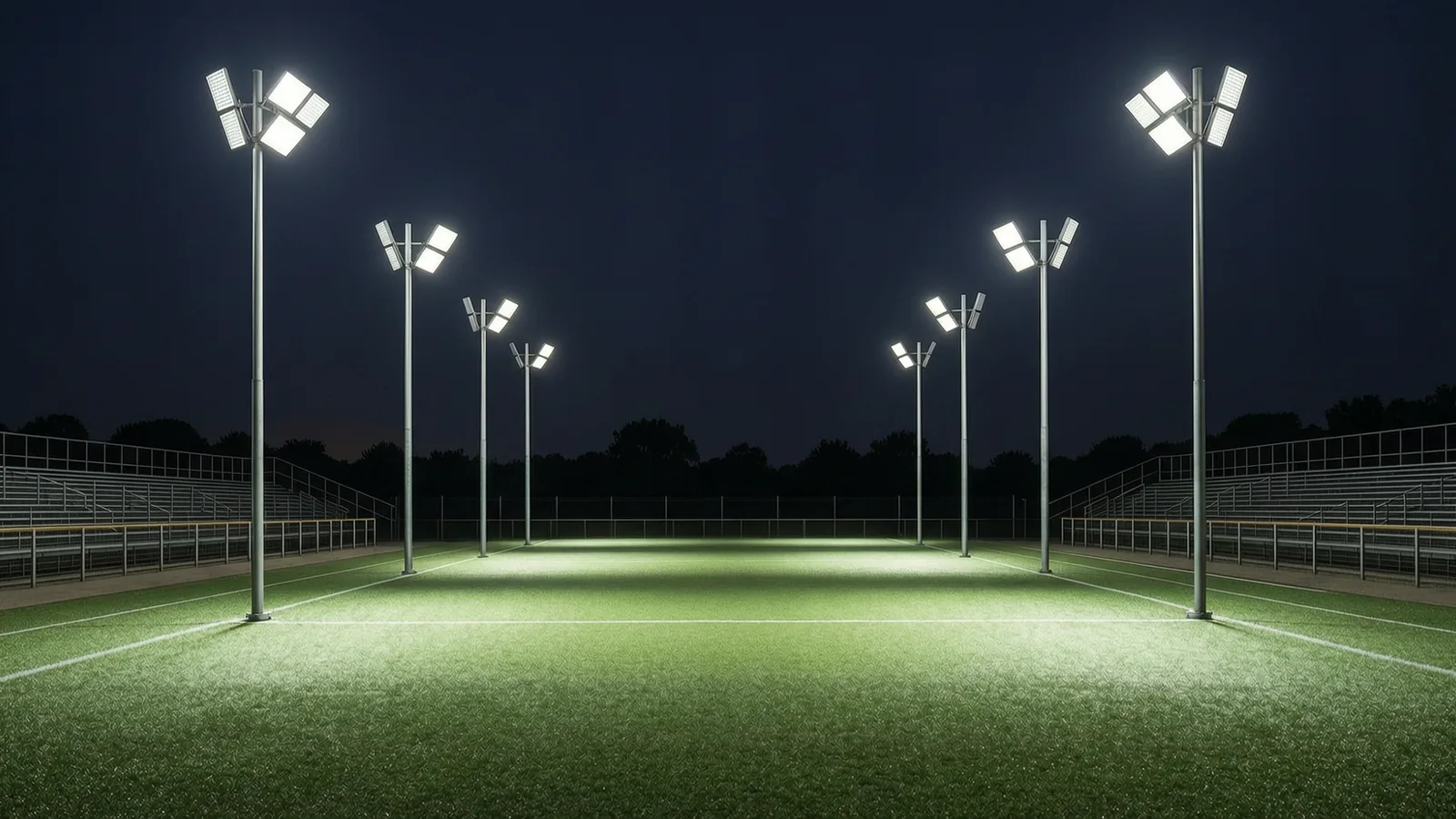
AI-generated illustration of a flood-light application or QC scene; not documentary photography of a Formore project or facility.
What does an LED flood light manufacturer do?
An LED flood light manufacturer designs and builds directional high-output luminaires for area, sports, security, facade, and industrial sites, rather than treating flood lights as a catalog add-on. Expect the factory to control housing and thermal path, optics, driver selection, sealing, mounting hardware, and finishes.
That is narrower than general LED manufacturing. For factory evaluation beyond this category, use the LED lighting manufacturer guide; this article stays on flood lights. Wider interiors are covered in the commercial LED lighting guide, and outdoor context in the outdoor lighting guide.
The rest of this guide uses four families: modular high-power, slim industrial, compact security, and solar flood lights.
Which types of LED flood lights are there?
Choose the family by area and power source, then lock optics and mounting. Modular high-power units suit large fields and yards; slim industrial units suit building-mounted wash; compact security units suit perimeters; solar flood lights suit off-grid sites. Compare those limits in the table before writing an RFQ.
Modular high-power flood lights such as a high-power modular LED flood light 400W are the usual starting point for sports fields, large yards, and port or logistics areas. Coverage depends on optic type and aiming, not on housing size alone.
Slim industrial flood lights such as an industrial LED flood light slim profile are often mounted on warehouse walls, yards, and facades. In a slim housing, driver location, heat path, and gasket design deserve as much attention as the optic. Where the goal is architectural facade effect rather than area lighting, use the architectural LED lighting guide.
Compact security flood lights such as a compact 50W LED security flood light serve perimeters, entrances, and building protection; specify beam and shielding to limit spill beyond the property line.
Solar flood lights serve off-grid yards, remote sites, and temporary areas—for example a smart solar flood light with remote control, a heavy-duty industrial solar flood light, and a compact solar security flood light. A solar street light is a related outdoor category covered in the solar street light manufacturer guide. For indoor industrial volumes, a UFO high bay LED light 200W/150W is adjacent, not a flood-light substitute.
| Flood light type | Typical use | Key specs to define | Common pitfall |
|---|---|---|---|
| Modular high-power | Sports fields, large yards, port and logistics areas | Beam angle and optics, glare control, thermal design, surge protection | Uneven coverage or glare from wrong optic and aiming |
| Slim industrial | Warehouses, facade wash, industrial exteriors | IP/IK rating, driver location, mounting brackets, finish | Driver heat and water ingress in slim housings |
| Compact security | Perimeter, entrances, building protection | Beam angle, CCT, sensor/control compatibility, IK rating | Over-lighting and light spill beyond the property line |
| Solar flood | Off-grid yards, remote sites, temporary areas | Panel and battery sizing, control modes, IP rating, mounting | Under-sized solar system for local sun hours |
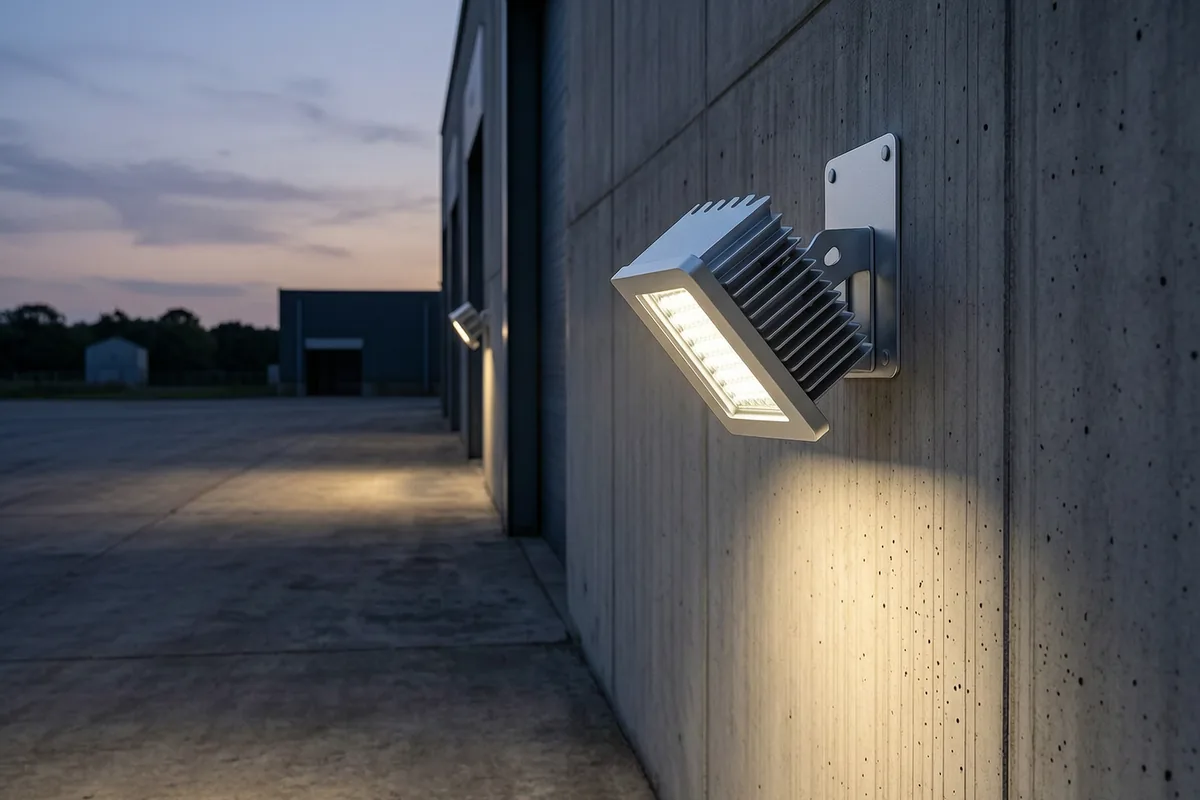
AI-generated illustration of a flood-light application or QC scene; not documentary photography of a Formore project or facility.
Which specs decide LED flood light performance?
Beam distribution, color quality, enclosure protection, surge handling, thermal design, and the driver work as a system. Specify them together for the mounting height and target surfaces. A wattage figure on a cut sheet does not, by itself, establish coverage or durability.
Compare useful output and distribution instead of treating wattage as a proxy, as explained in lumens vs watts.
For beam angle lighting decisions, narrow optics suit throw and accent, wider optics suit even area coverage, and asymmetric optics can limit spill. Confirm with an IES photometric file and a sample; see the beam angle guide for commercial lighting.
Keep CCT consistent across a project and match it to the application; see the color temperature guide. CRI matters where surfaces or people are judged under the light; see what is CRI in lighting.
IP covers ingress protection against dust and water; IK covers mechanical impact. Request evidence against IEC 60529 and confirm the installation conditions. An IP rating alone does not prove suitability for every mounting.
Write surge protection into the outdoor flood-light specification rather than assuming it. Thermal design—heatsink, housing airflow, and driver placement—affects output stability; ask how heat is managed instead of relying on open-ended lifetime claims.
Specify the driver, dimming protocol, and any sensor or remote-control interface together, and check compatibility with the LED dimming guide.
Which compliance requirements should buyers ask about?
Treat compliance as a document checklist for the exact model and destination market, not a claim about any one factory. Ask for reports that name the SKU you will buy; a standard number on a brochure is not proof of certification.
For luminaire safety, request test evidence against IEC 60598 and, for North America, applicable UL 1598 or ETL listings. For ingress protection, request IEC 60529 verification for the intended outdoor or wet location. CE may be required for the EU; other markets can add local rules.
If U.S. utility incentives matter, ask whether the model is listed by the DesignLights Consortium (DLC) and request listing evidence. For photometry and package reliability, request IES LM-79 for the finished luminaire and IES LM-80 with TM-21 projections for the LED package used in production.
The DarkSky and IES outdoor-lighting principles call for useful, targeted, controlled light at appropriate levels, with warmer colors where possible. Specify shielding and aiming, and limit spill onto neighboring property and unnecessary uplight.
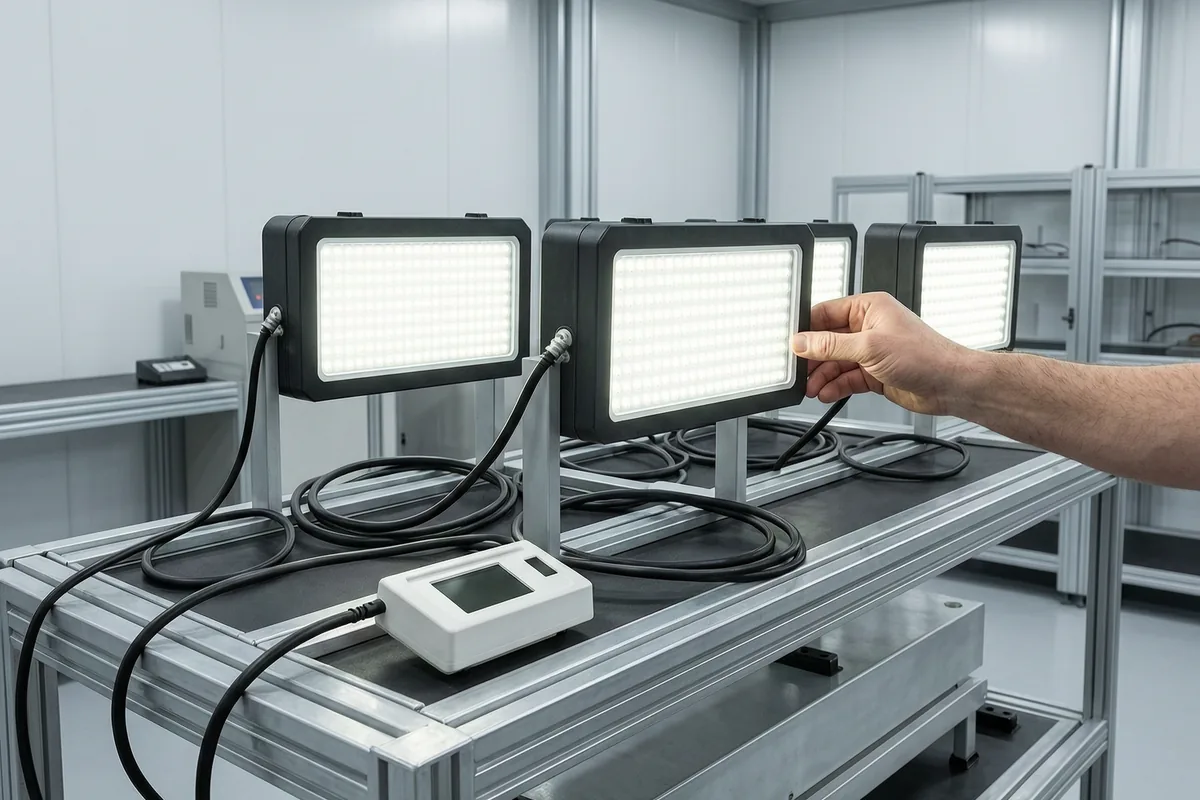
AI-generated illustration of a flood-light application or QC scene; not documentary photography of a Formore project or facility.
How do you vet an LED flood light manufacturer?
Evaluate an LED flood light manufacturer against the full fixture schedule, not one sample. Confirm category fit across the flood light types you need, then request IES photometric files for every optic, a documented sample program, and batch CCT/finish consistency. Ask how inspections are recorded and how substitutions are approved.
Use this checklist when you compare factories:
- Review incoming, in-process, and outgoing gates through incoming quality control, in-process quality control, and outgoing quality control.
- See how a factory-direct process is described under factory-first manufacturing.
- If you need a custom housing, optic, or finish, confirm whether the partner can act as an OEM LED lighting manufacturer, and use the OEM vs ODM lighting guide to settle design and tooling ownership.
- For an LED lighting manufacturer China search, pair this category check with how to source LED lights from China and China lighting sourcing.
A capable LED flood light manufacturer should walk through these points with files that match the quoted model.
What should a flood light RFQ include?
An RFQ should turn the site into testable requirements for each area so every bidder quotes the same scope. Keep confirmed requirements separate from optional alternates, and review substitutions before samples or production.
- Application, mounting height, and fixture type per area.
- Beam angle or distribution targets, plus aiming notes.
- CCT and CRI requirements, kept consistent across the project.
- IP and IK requirements based on actual exposure.
- Surge protection requirements for the electrical environment.
- Driver, dimming protocol, and any sensor or control interface.
- Finish, brackets, and mounting details.
- Destination-market compliance documents to be supplied with the model.
- Sample plan and IES photometric file requests for each optic.
- Packaging, labeling, inspection plan, change control, and Incoterms.
Review project cases and lighting solutions for application context; a lighting solution provider can help coordinate mixed-area schedules.