Specifying commercial LED lighting requires balancing photometric performance, energy efficiency, and lifecycle costs. This guide helps B2B buyers navigate fixture types for offices, retail, and warehouses, decode critical specs like UGR and L70, and understand the certifications needed to source reliable commercial LED lighting from a qualified manufacturer.
What counts as commercial LED lighting?
Commercial LED lighting covers luminaires specified for workplaces, public venues, and production spaces rather than homes. Compared with residential fixtures, it demands higher durability under long operating hours, stricter safety certifications, tighter photometric control, and a clear focus on total cost of ownership (TCO). LED lighting for commercial buildings also has to align with architectural layouts, energy codes, and control strategies. For foundational industry acronyms used on commercial submittals, start with the LED terminology guide.
Which fixture types suit specific commercial spaces?
Match the fixture family to the visual task first, then refine wattage, optics, and mounting. The table below is a conceptual map—not a fixed bill of materials—for common commercial LED lighting fixtures.
| Space | Primary lighting goal | Typical fixture focus |
|---|---|---|
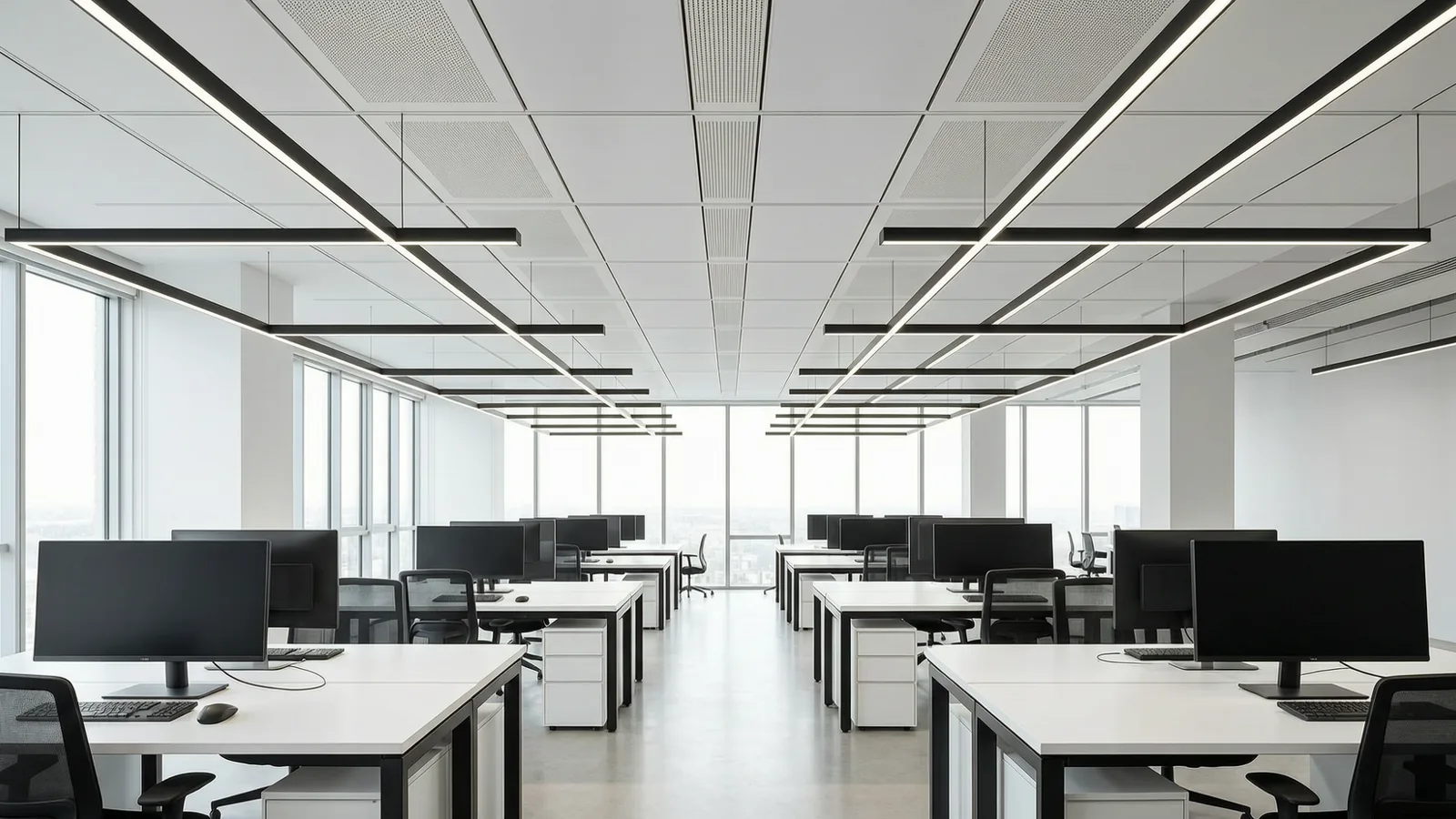
| Offices | Glare control and uniform task light | Suspended linear, slim surface panels |
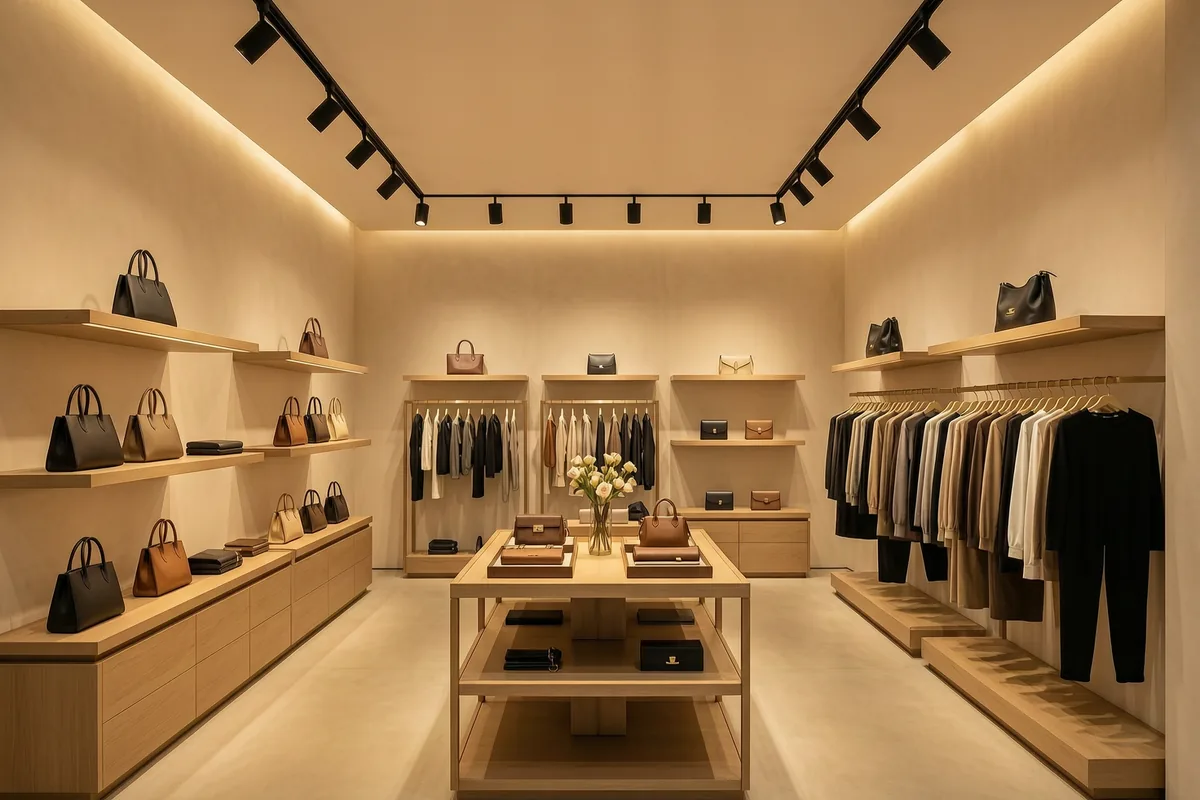
| Retail | High CRI and merchandise accent | Track spots and high-power track heads |
| Hospitality | Aesthetics and smooth dimming | Trimless recessed downlights |
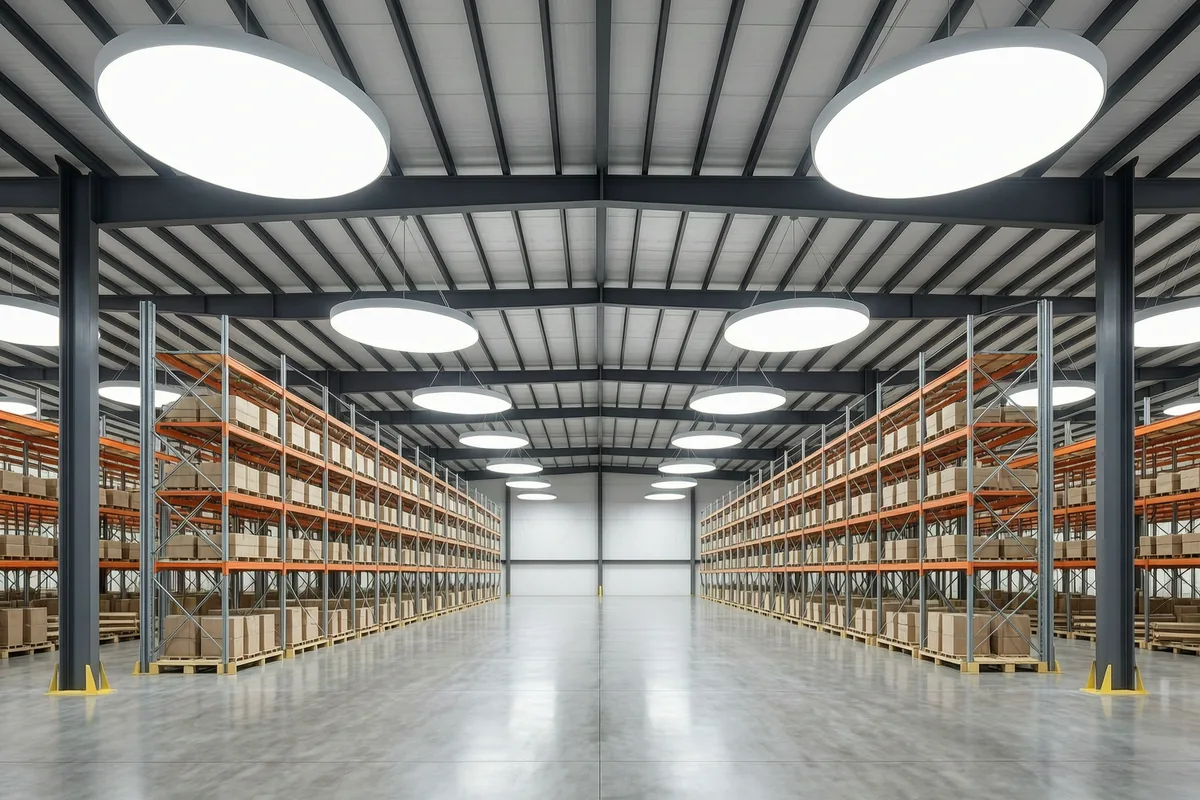
| Warehouses / industrial | High output and rugged build | UFO high bays |
| Outdoor / facade | Weather and impact resistance | IP/IK-rated exterior systems |
Offices. Desk work and screens make glare the first filter. Prioritize low-UGR layouts and even desk illuminance with commercial LED lighting for offices, and use an ultra-slim round surface panel light where a clean ceiling plane matters. Deeper linear system options are covered in the LED linear light guide.
Retail. Merchandise needs accurate color and controlled accents. Combine ambient light with commercial LED lighting for retail and a high power 40W retail track light for focal walls or gondolas.
Hospitality. Guests notice finish quality and dimming feel as much as brightness. A trimless recessed COB downlight supports clean ceilings and scene-based control in lobbies, corridors, and F&B zones.
Warehouses / industrial. High mounting heights call for durable, high-output luminaires. A UFO high bay LED light is a common platform when aisle uniformity, thermal design, and impact resistance drive the brief.
Outdoor / facade. Exterior LED lighting for commercial buildings needs documented IP and IK performance plus corrosion-aware materials. For multi-elevation or mixed indoor–outdoor scopes, work with a commercial lighting solution provider who can coordinate photometrics across zones.
What are the key technical specifications to specify?
A commercial submittal package should make performance auditable before you compare unit price. Start with light quantity and efficiency: delivered lumens and efficacy (lm/W). Use lumens vs watts when stakeholders still negotiate on wattage alone.
Color quality and appearance come next. Confirm CRI (and R9 when merchandising or finishes matter) via what is CRI in lighting, then lock CCT with the color temperature guide so adjacent spaces do not drift in appearance.
For offices, glare is a hard constraint. Review UGR against the layout method in UGR office lighting explained. Optics selection belongs in the same conversation—see the beam angle guide for commercial lighting when you move from general ambient light to accent or aisle beams.
Controls must be named on the schedule, not left as “dimmable.” Pair fixture dimming curves with the protocols in the dimming guide. Add IP and IK ratings wherever moisture, dust, or impact is expected. Lifetime language should reference lumen maintenance methods such as L70 supported by LM-80 source data and TM-21 projections—ask for the reports rather than accepting open-ended “long life” claims.
How do controls and drivers impact system performance?
The LED package is only half the system. Driver quality governs thermal stress, flicker behavior, dimming smoothness, and field failure risk across commercial LED lighting fixtures. Specify driver brand family, dimming range, and surge protection where the electrical environment is harsh, and require flicker-related evidence appropriate to the market.
Smart controls—0–10 V, DALI, or wireless platforms such as Casambi—cut energy use by aligning light with occupancy and daylight. Integrated track ecosystems are one practical path; the magnetic track lighting guide shows how power, data, and optics can share one infrastructure in retail and gallery-style commercial floors.
Which certifications and compliance standards are mandatory?
Treat compliance as a document checklist tied to the exact SKU you will ship, not a marketing badge on a catalog page. A serious commercial LED lighting manufacturer should be able to produce product-specific files on request:
- Luminaire safety — IEC 60598 for global reference and UL 1598 for North America.
- Photobiological safety — IEC 62471 for optical radiation risk classification.
- Energy and rebates — DLC listing and ENERGY STAR where the product category and market expect them.
- Market access — CE and RoHS for Europe, plus any local energy-code documentation the AHJ requires.
- Lumen maintenance — IES LM-80 source test data with TM-21 projections that match the LED package used in production.
Reject certificates that name a different model, wattage, or optic than the line item on your PO.
How do you evaluate lifecycle cost and compare quotes?
Unit price alone rarely ranks commercial LED lighting correctly. Build a TCO view that includes driver quality, LED package pedigree, warranty structure, expected maintenance access, and projected energy use under your control strategy. Ask each bidder for IES files and a transparent calculation method so lumen packages and distribution can be compared on equal footing.
When customization enters the scope, clarify whether the path is catalog, private label, or full custom. The OEM vs ODM lighting guide and OEM/ODM lighting services help you decide who owns design, tooling, and IP before you negotiate commercial terms. Prefer suppliers who support ROI discussion with photometric evidence rather than discount-only quotes.
What are the most common buyer mistakes in commercial lighting?
- Ignoring UGR limits in offices, which often leads to glare complaints after occupancy.
- Accepting low-cost drivers that fail early and erase energy savings through callbacks.
- Choosing the wrong IP rating for damp, dusty, or outdoor locations.
- Skipping physical sample approval before mass production.
- Ranking quotes only on upfront unit cost instead of lifecycle efficacy and warranty coverage.
How do you move from specification to sample and order?
Freeze the technical brief, IES files, finishes, and control interfaces first. Request physical samples to verify build quality, color, and beam behavior under your own ceilings. Define an inspection protocol covering incoming, in-process, and outgoing checks before you release mass production. For China-based supply chains, pair this workflow with how to source LED lights from China and review Formore lighting experience for how factory-first processes are presented—then confirm every commercial term in writing and contact Formore when you are ready to open a project discussion.