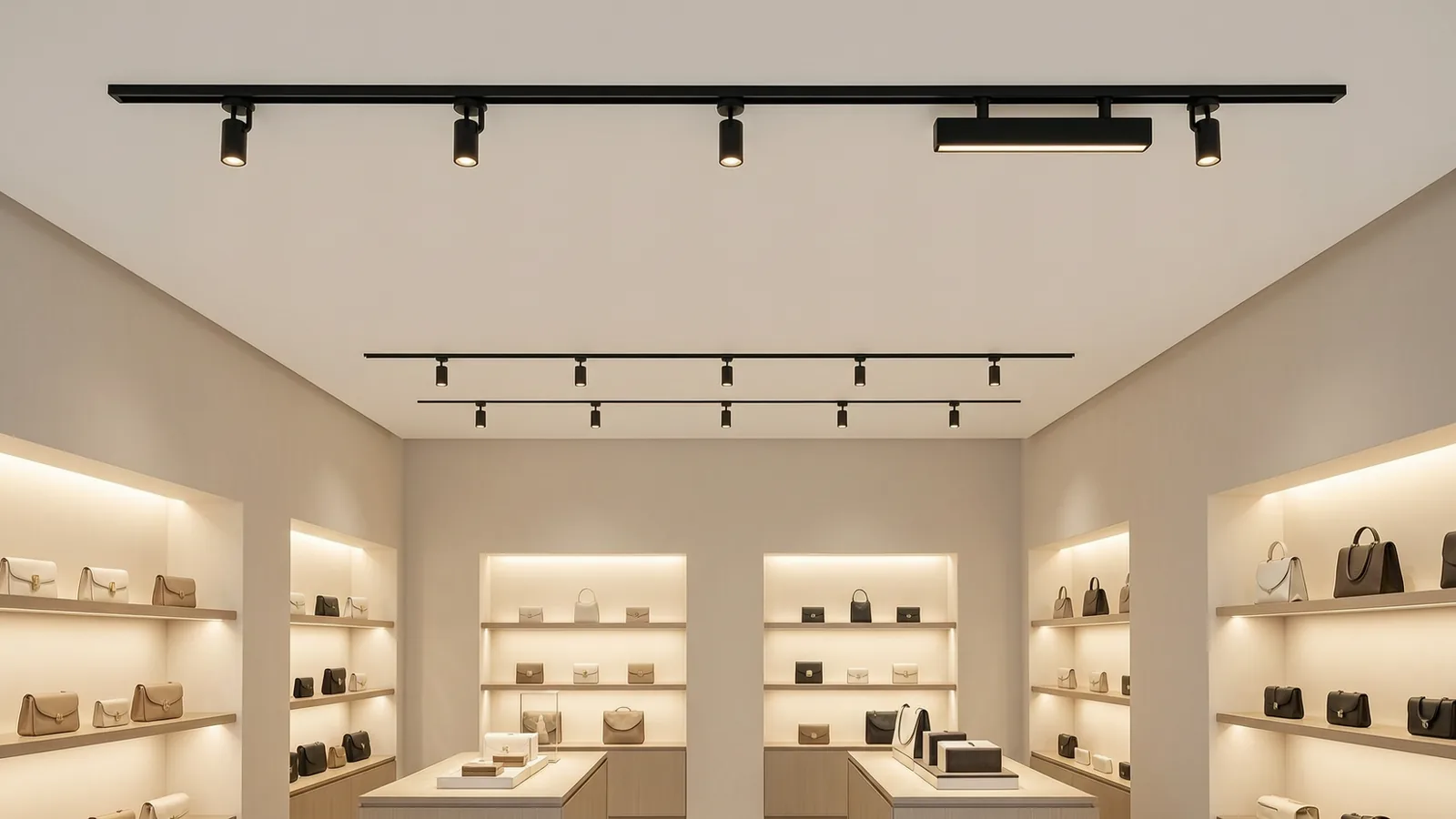
Magnetic track lighting is a low-voltage DC system — commonly 48V — where track, driver, and magnetic modules combine into one flexible platform. Choosing a supplier comes down to verified driver quality, honest photometric data, module and track compatibility, and clear OEM/ODM terms. Compare specs, not marketing, before you commit to a purchase order.
What Is Magnetic Track Lighting and How Does It Work?
Magnetic track lighting is a three-part low-voltage platform: the track carries power and the magnetic attachment surface; a remote or integrated driver converts mains AC to low-voltage DC — commonly 48V — often as a SELV system under IEC 61140; and magnetic modules snap onto the track and draw power through contacts.
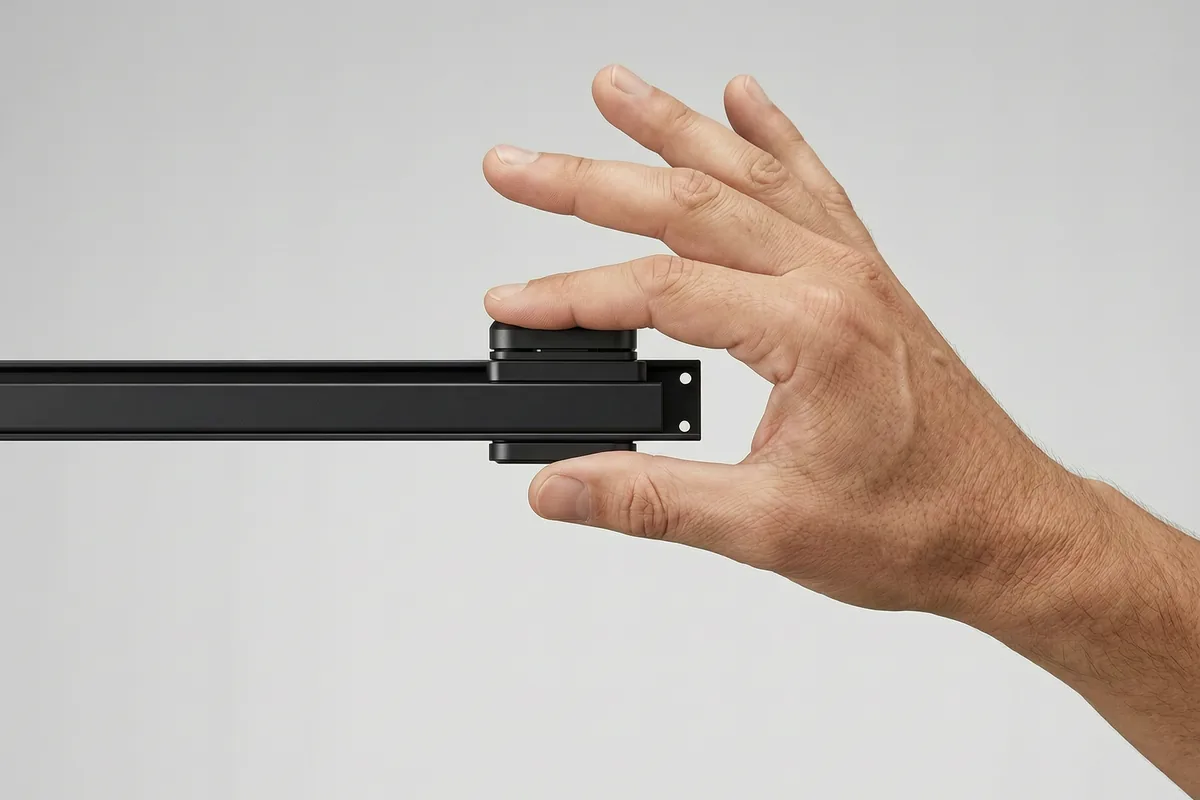
The track profile may be recessed, surface-mounted, or suspended. Recessed profiles suit finished plaster ceilings; surface profiles fit concrete soffits; suspended profiles drop the lighting plane independently of the structure. The driver may sit in a ceiling void, cabinet, or integrated feed. Modules — spotlights, linear units, grille optics, and pendants — attach magnetically and can be repositioned without tools. That tool-free change is the core design advantage for retail and hospitality layouts that evolve over time.
For how track, feed, and modules combine as one platform, see the magnetic track light system.
Magnetic Track Lighting vs Traditional Line-Voltage Track — What's the Difference?
Both put adjustable fixtures on a ceiling rail. The differences that matter to B2B buyers are voltage architecture, driver location, module swapping, fixture profile, safety, and installation planning.
| Magnetic track lighting | Traditional line-voltage track | |
|---|---|---|
| System voltage | Low-voltage DC, commonly 48V (SELV) | Mains line voltage |
| Driver | Remote or integrated driver feeds the track | Driver built into each fixture or track adapter |
| Module changes | Tool-free magnetic snap-on; reposition by hand | Mechanical/electrical adapter; often tool-assisted |
| Fixture profile | Compact, minimal modules | Larger bodies to house drivers |
| Safety profile | SELV architecture reduces shock risk | Mains voltage present along the track |
| Installation | Driver planning and voltage-drop checks required | Simpler electrically, heavier fixtures |
| Best fit | Design-led retail, hospitality, residential, office | High-output industrial, retrofit, budget-driven projects |
If your project needs conventional high-output accent heads rather than a low-voltage magnetic platform, evaluate a commercial track light as an alternative.
Which Module Types Are Available in a Magnetic Track System?
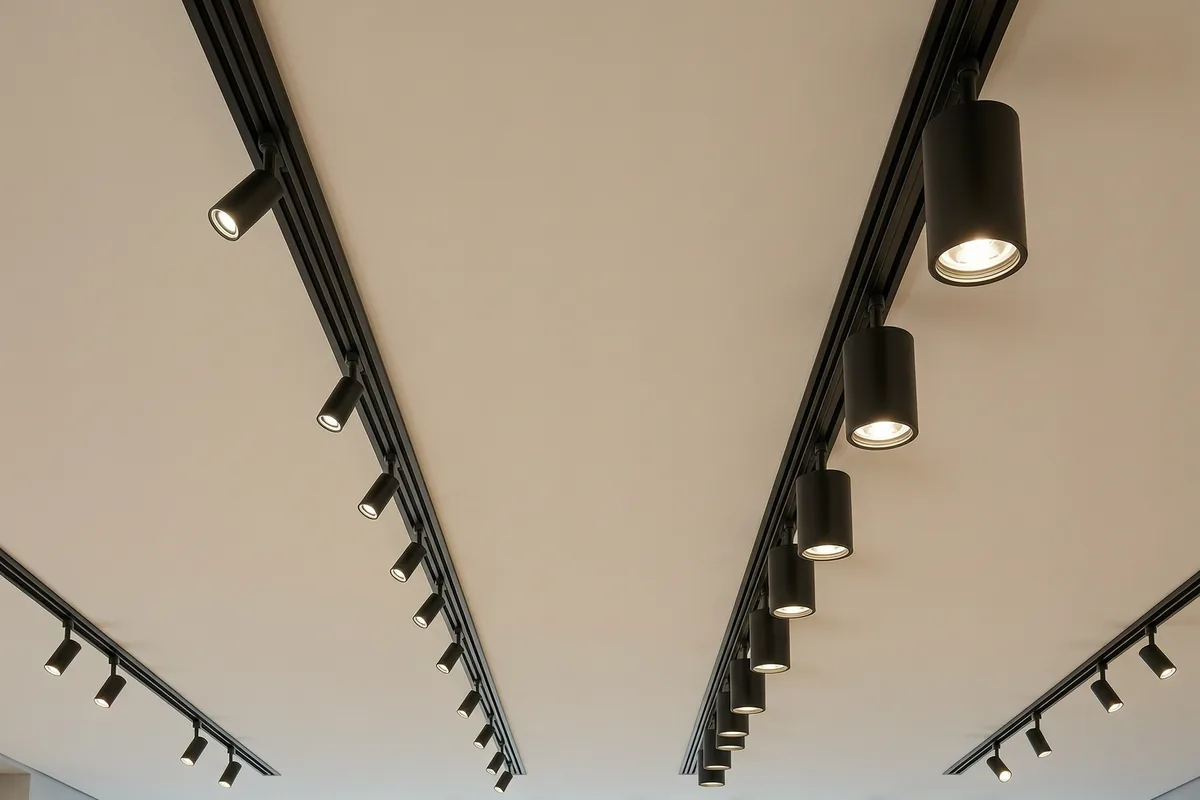
Most magnetic track platforms offer four module families that share one rail.
- Spotlights — adjustable aiming for accent and display lighting. See the magnetic track spotlight module for typical configurations.
- Linear / flood modules — wall-wash and general fill along the track so accent and ambient can share one circuit.
- Grille / anti-glare modules — honeycomb or louvered optics that control glare. An anti-glare track spotlight is often preferred where occupants sit near the ceiling plane; glare principles in UGR in office lighting still apply.
- Pendants — decorative drop modules for hospitality and residential feature lighting on the same rail.
Beam angle choice drives performance more than housing style. Match optic to throw distance and merchandise; use the beam angle guide and request photometric files for the exact SKU.
Where Does Magnetic Track Lighting Fit Best?
Retail. Flexible merchandising is the strongest case. A retail track light on a magnetic rail lets teams re-aim for new displays without scheduling an electrician. The clean ceiling line also supports minimalist retail lighting programs.
Hospitality. Bars, restaurants, and hotel lobbies use one track line for accent spots, wall-wash linear modules, and pendants, then reconfigure between seasons or events.
Residential. Recessed profiles keep ceilings low-profile while modules stay adjustable for accent tasks.
Office. Linear and anti-glare modules suit meeting rooms and collaboration zones where glare control and layout changes both matter.
Which Specifications Should You Verify Before Ordering?
Ask for documentation on each point — a verbal confirmation is not a specification.
- System voltage and SELV classification — confirm the rated DC voltage (commonly 48V) and SELV status per IEC 61140.
- Driver sizing and voltage drop — driver wattage must cover total module load plus headroom; long runs need voltage-drop checks. Evaluate drivers to IEC 61347.
- CRI and R9 — color fidelity matters for retail and hospitality; see what is CRI in lighting.
- UGR — glare control for office and task environments; reference CIE/IES glare guidance.
- Beam angle — match optic to throw distance; confirm with photometric files.
- Dimming protocol — DALI, 0-10V, Triac, or Zigbee; match driver and control system via DALI-2 vs 0-10V dimming.
- Track profile — recessed, surface, or suspended; confirm ceiling conditions.
- Brand compatibility — mechanical and electrical interfaces are not universally interchangeable; specify track, driver, and modules as one matched system.
- Photobiological safety — confirm modules are assessed to IEC 62471.
- Luminaire safety — confirm fixtures are tested to IEC 60598 and, where applicable, UL 1574 for track lighting systems.
What Should Buyers Ask a Magnetic Track Light Supplier About OEM/ODM?
Start with the OEM/ODM lighting overview, then ask process questions in writing:
- Tooling ownership for custom track profiles and module housings
- Custom finishes, branding, and packaging
- Sample lead time and production lead time for your configuration
- MOQ per SKU and per finish (ask for a written quote — do not assume a default)
- Inspection options and the outgoing quality control (OQC) procedure
- Warranty terms, especially for driver failures
- Whether you are buying factory-direct or through a trader
Do not accept blended MOQ or lead-time answers that skip SKU-level detail.
What Are the Most Common Magnetic Track Lighting Mistakes?
- Undersizing the driver relative to total connected module load
- Ignoring voltage drop on long track runs
- Mixing modules and tracks from incompatible suppliers
- Specifying high CRI without checking R9
- Choosing beam angles by appearance rather than throw distance
- Skipping dimming-protocol compatibility checks between driver and control system
How Do You Move from Spec Sheet to Purchase Order?
- Request samples of track, driver, and modules as a matched set — and test dimming at low levels.
- Verify driver test reports and photometric files for the exact SKUs.
- Confirm dimming compatibility in writing.
- Confirm warranty scope and lead time in writing.
- Place a trial order before scaling to the full project quantity.