An LED lighting manufacturer designs, builds, and tests fixtures in its own factory rather than only brokering catalog products. B2B buyers should verify production lines, quality gates, certifications, and photometric files, then decide whether a catalog, OEM, or ODM path fits the project. This guide shows how to evaluate a manufacturer without repeating a full China-sourcing or OEM-versus-ODM deep dive.
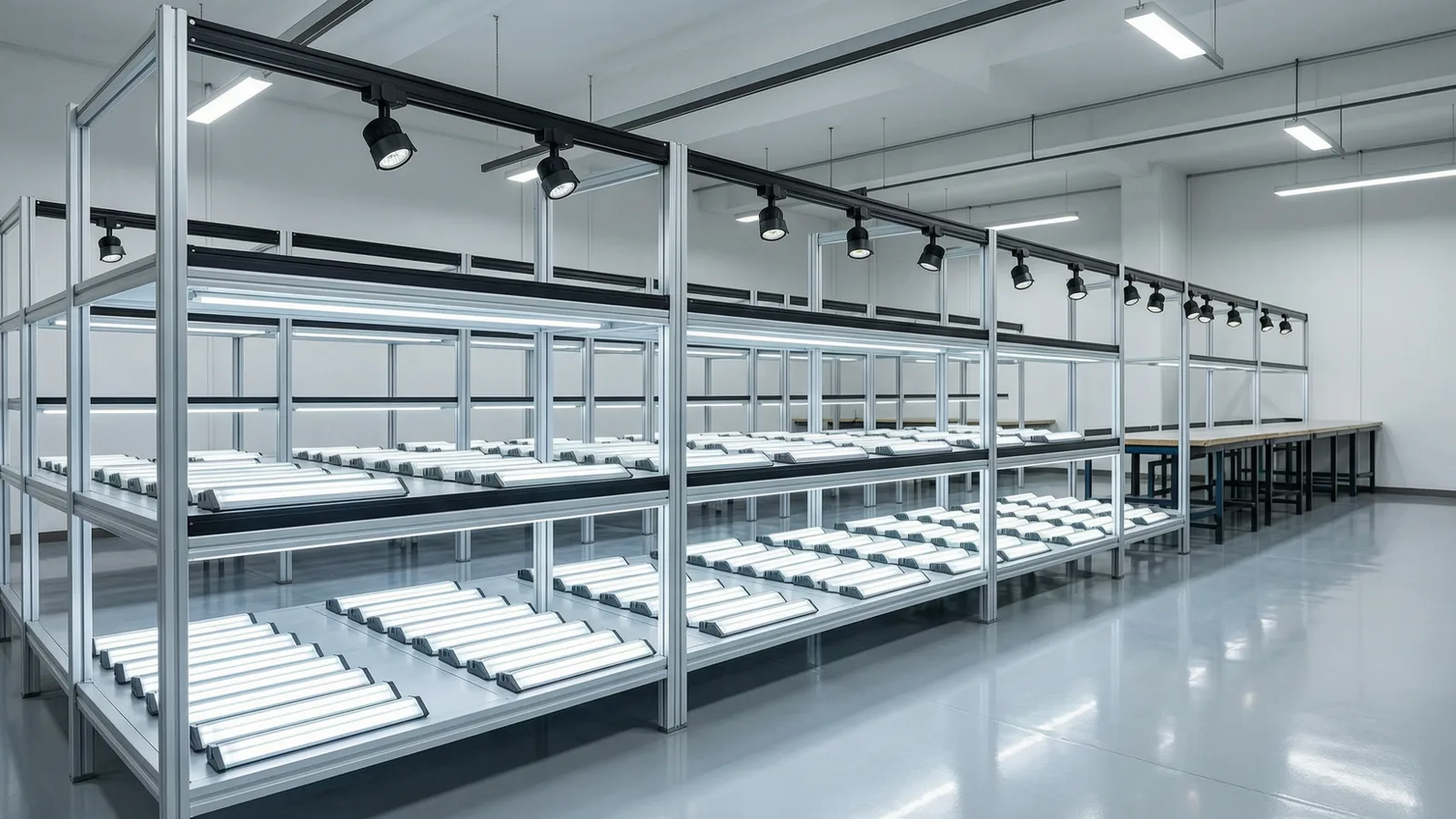
AI-generated illustration of a manufacturing or showroom setting; not documentary photography of Formore facilities.
What should B2B buyers expect from an LED lighting manufacturer?
Evaluate how an LED lighting manufacturer controls design and tooling, component sourcing, assembly, aging and photometric checks, packaging, and shipment documentation. Ask which processes, including SMT where relevant, are performed in-house and which are subcontracted. Buyers should be able to trace a sample back to the line and the people who built it.
Most commercial ranges cover a few core families: linear, track, flood, high bay, and solar street lighting. For application context, start with the commercial LED lighting guide. Indoor families have their own buying guides—the LED linear light guide, the commercial track light guide, and the magnetic track lighting guide. Outdoor solar has a dedicated solar street light manufacturer guide.
When you review a range, ask to see real examples across families, such as a commercial COB track spotlight 30W, a magnetic track light system linear, a high power modular LED flood light 400W, a linear bar office suspended light, or an all-in-one solar street light. The full catalog sits under commercial LED products, and typical applications under lighting solutions.
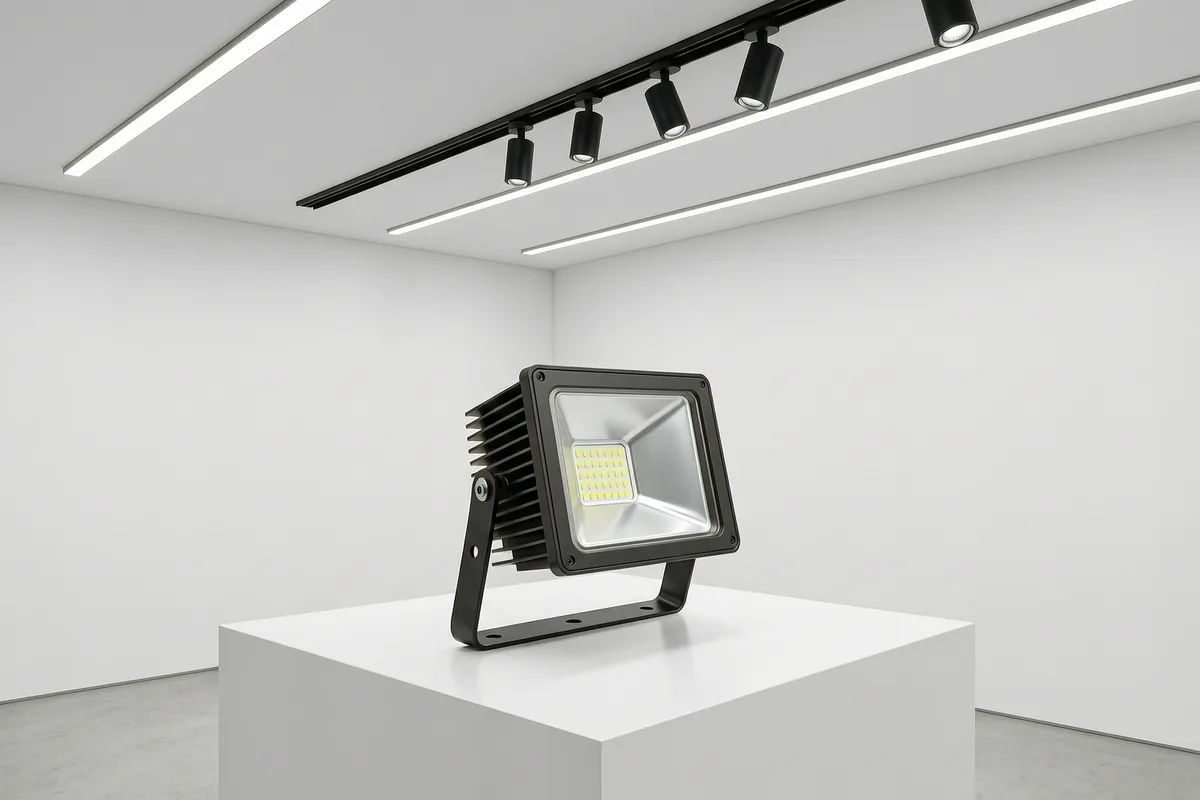
AI-generated illustration of a manufacturing or showroom setting; not documentary photography of Formore facilities.
How do you distinguish a true manufacturer from a trading company or lighting sourcing agent?
The factory of record matters. It is the party that answers for repeat-order consistency, quality claims, and any OEM or ODM tooling. Many commercial lighting suppliers present themselves as factories, so buyers need a simple way to tell the roles apart.
| Criterion | LED lighting manufacturer | Trading company | Lighting sourcing agent |
|---|---|---|---|
| Core role | Designs and builds fixtures in its own factory | Sells products sourced from one or more factories | Helps the buyer find, audit, and manage factories |
| Typical strength | Process control, tooling, customization, quality gates | Broad catalog access and faster quoting | Multi-factory comparison and on-the-ground coordination |
| What you can verify | Production lines, IQC/IPQC/OQC, test equipment, sample traceability | Supplier network and logistics, not always the production floor | Audit reports, negotiation support, shipment follow-up |
| Best fit | Repeat OEM/ODM or controlled quality on a defined range | Spot buys when the factory relationship is already proven | Buyers who need help navigating multiple China factories |
| Watch-outs | Capacity and category fit still need proof | Factory of record may change between orders | Scope and fees must be clear; the agent is not the factory |
A lighting sourcing agent can be useful for a factory audit in China, but the agent is not the manufacturer. For the full sourcing process, see how to source LED lights from China, China lighting sourcing, and navigating Shenzhen. To see how a factory-direct model is described, review factory-first manufacturing and about Formore.
Which factory capabilities and quality checks actually matter?
Quality gates are only useful if you can see them working. Ask the factory to walk you through three stages:
- Incoming checks. How LEDs, drivers, housings, and optics are verified on arrival—see incoming quality control.
- In-process checks. Solder and assembly inspection on the line, plus electrical safety tests such as hipot and ground continuity on finished units.
- Outgoing checks. Final inspection, aging, and packaging review before shipment—see outgoing quality control.
Aging tests and photometric verification should be routine, not something arranged only for your visit. Ask how the factory keeps CCT, CRI, and finish consistent from batch to batch, and what happens when a batch drifts. Check color specs on the sample itself; what is CRI in lighting and 3000K vs 4000K LED cover what to ask for. Request IES-format photometric files, the standard data format defined by the Illuminating Engineering Society, so your designers can model the fixture. Strong process control here is what factory-first manufacturing should mean in practice.
Which certifications and files should you request from an LED lighting manufacturer?
Ask for documents tied to the exact SKU you will buy, not a generic catalog certificate. Do not assume any certificate is in place; ask for the report.
- Electrical safety: UL 1598 for North America and IEC 60598-1 as a general luminaire safety reference. Confirm the applicable product-specific parts, national requirements, and accepted test reports for the destination market.
- Color metrics: CRI and CCT data aligned with CIE definitions, such as correlated color temperature.
- Efficiency listings, when the project needs them: check DLC eligibility for applicable commercial products and ENERGY STAR for eligible downlights. ENERGY STAR no longer labels most other light-fixture categories. Verify the exact model and the utility rebate requirements rather than assuming either program covers every fixture.
- Project files: IES photometric files, CAD drawings, test reports, and sample traceability.
Office projects often ask for glare data as well; see UGR office lighting explained.
How do OEM, ODM, and catalog programs change the manufacturer decision?
The program you choose changes what you need from the factory:
- Catalog / private label: the manufacturer's existing design with your branding and packaging. Fastest path, least control.
- OEM: you bring the design; an OEM LED lighting manufacturer builds it. Agree on tooling ownership and the required sample rounds in writing.
- ODM: an ODM lighting manufacturer develops or adapts the design for you. Confirm who owns the tooling and the design files.
In any lighting OEM/ODM program, agree on tooling ownership, sample iterations, packaging artwork, and documentation in writing. For the full comparison, read the OEM vs ODM lighting guide, and see OEM/ODM lighting services for how custom work is scoped.
What belongs in an RFQ when you contact an LED lighting manufacturer in China?
Buyers evaluating an LED lighting manufacturer in China get more comparable quotes when the RFQ is complete. Include:
- Product family and approximate quantities.
- Target CCT, CRI, beam angle, and UGR where relevant.
- Dimming protocol, IP and IK ratings, and finishes.
- Destination-market certifications, such as UL 1598 or IEC 60598 test reports.
- Packaging, labeling, inspection plan, and Incoterms.
- A sample plan with approval criteria.
A factory audit in China is a sensible due-diligence step before a first order. Process details are in how to source LED lights from China and China lighting sourcing.
How do you move from sample approval to a repeatable production order?
Evaluate the sample against the written specification: build quality, finish, optics, labeling, and packaging. Once approved, both sides should sign and keep a reference unit, and the bill of materials should be locked so key parts such as LEDs and drivers cannot change without written consent.
Next, run a pilot lot and inspect it against the approved sample using outgoing quality control criteria, then release the bulk order. To start a project, contact Formore, review OEM/ODM lighting services and factory-first manufacturing, or work with a commercial lighting solution provider for multi-family projects.