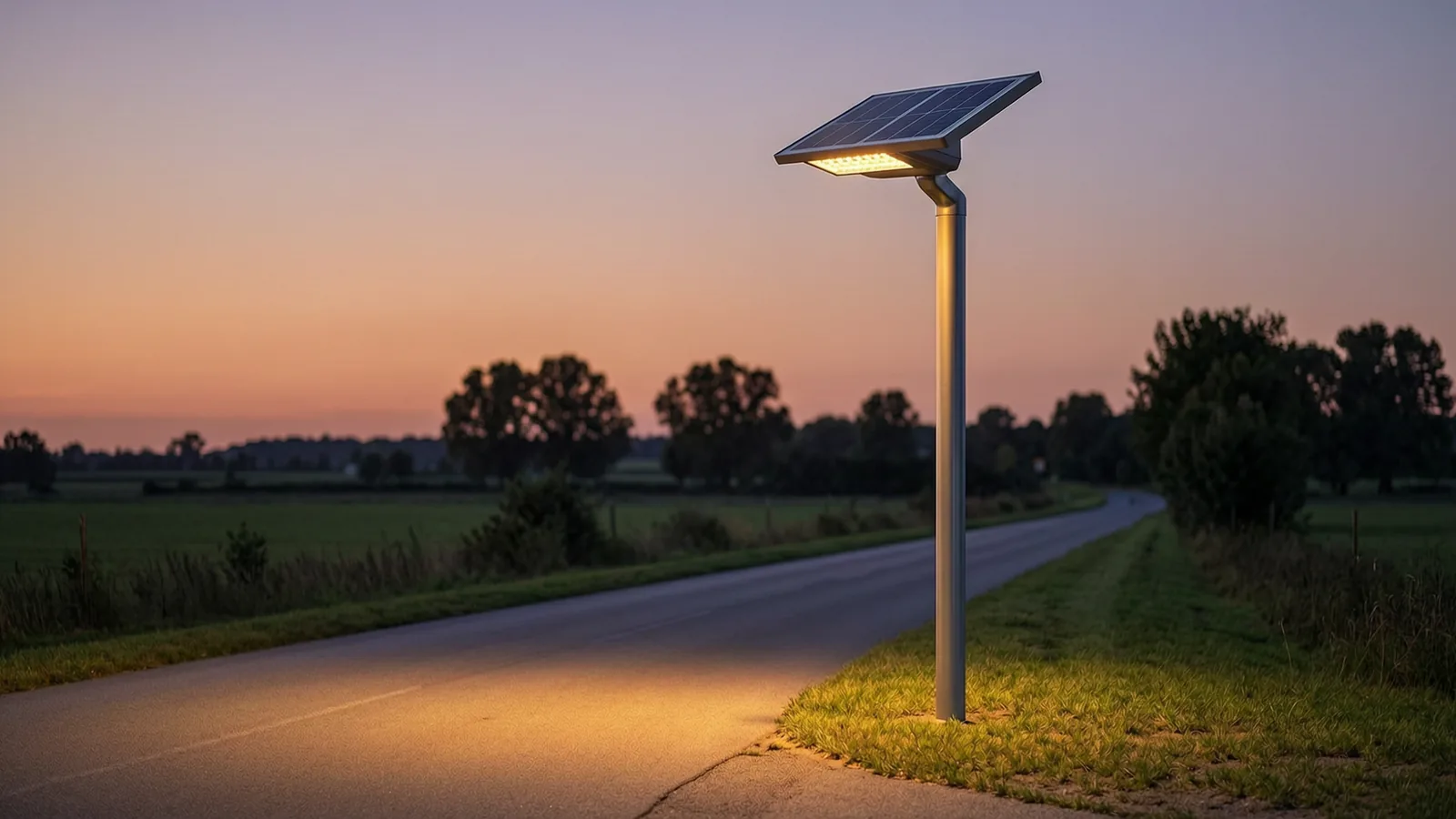
Choosing a solar street light manufacturer comes down to four things: verified factory capability, certified components (IEC 62133 batteries, IEC 60598 luminaires, IEC 61215 panels), honest specification data, and a warranty you can enforce. Compare all-in-one vs split systems against real site conditions, then confirm test reports, MOQ, and lead time before committing to a supplier.
All-in-One vs Split Solar Street Light: Which Fits Your Project?
The right architecture depends on road class, sun hours, wind exposure, and how easily your maintenance team can reach the fixture. All-in-one designs win on installation speed and compactness; split designs win on output capacity and serviceability in harsh climates.
There are two mainstream architectures. An all-in-one solar street light integrates panel, battery, controller, and LED in a single housing. A split solar street light separates the panel from the battery/controller enclosure, with the LED on its own arm or fixture. Neither is universally better — the fit depends on the project.
| All-in-one solar street light | Split solar street light | |
|---|---|---|
| Component layout | Panel, battery, controller, LED integrated | Panel separate; battery/controller separate |
| Installation | Single unit, faster mounting | More cabling, multiple mount points |
| Maintenance | Compact, replace as module | Easier to service individual parts |
| Battery protection | Compact enclosure, heat considerations | Battery box placement more flexible |
| Wind/load profile | Lower pole load, compact | Higher pole load; needs structural checks |
| Best fit | Roads with limited space, retrofit | High-output roads, harsh climates |
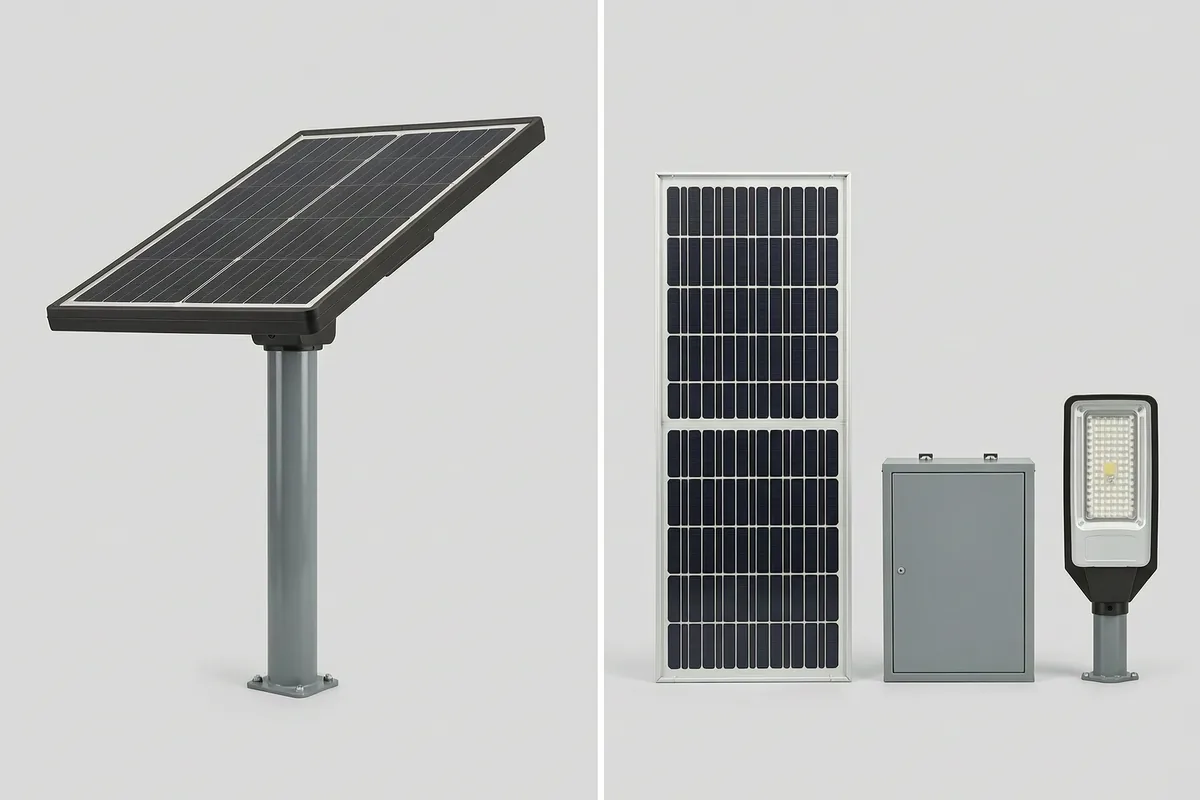
Maintenance access is the deciding factor most buyers underestimate. If your team cannot reach a pole safely and quickly, choose the architecture that lets you service the battery and controller without dismantling the whole head. For high-wind coastal or open-plain roads, look at a windproof split solar street light where structural load is a design constraint.
Which Specifications Actually Matter When Comparing Solar Street Lights?
Five numbers separate a real datasheet from a brochure claim: panel wattage, battery Wh and chemistry, system lm/W, autonomy days, and IP/IK. Everything else is secondary until those five are honest.
- Panel wattage (W): Must cover daily load plus recharge losses. Ask for the panel's IEC 61215-1 certificate — see IEC 61215-1.
- Battery watt-hours (Wh) and chemistry: Specify LiFePO4 and confirm Wh at the stated system voltage. Request the IEC 62133-2 report (IEC 62133-2).
- System efficacy (lm/W): Compare at the system level, not just the LED. A 150 lm/W solar street light claim should come with a photometric report for that model.
- Autonomy (days): Consecutive no-sun days the battery must carry the load. Match local weather patterns, not a catalog default.
- IP and IK ratings: IP65 handles dust and water jets; IK08 covers impact. The luminaire should conform to IEC 60598-1 (IEC 60598-1).
- Controller type: MPPT recovers more energy than PWM in most conditions. Confirm the model and its rated current.
- Pole height and spacing: Driven by road class and target illuminance — reference ANSI/IES RP-8 for roadway practice (ANSI/IES RP-8).
A LiFePO4 solar street light with honest Wh data will outperform a cheaper unit with inflated numbers every time.
How Do You Evaluate a Solar Street Light Manufacturer?
Evaluate four layers: factory capability, component certifications, sample verification, and enforceable after-sales. Documents and a test sample matter more than marketing pages.
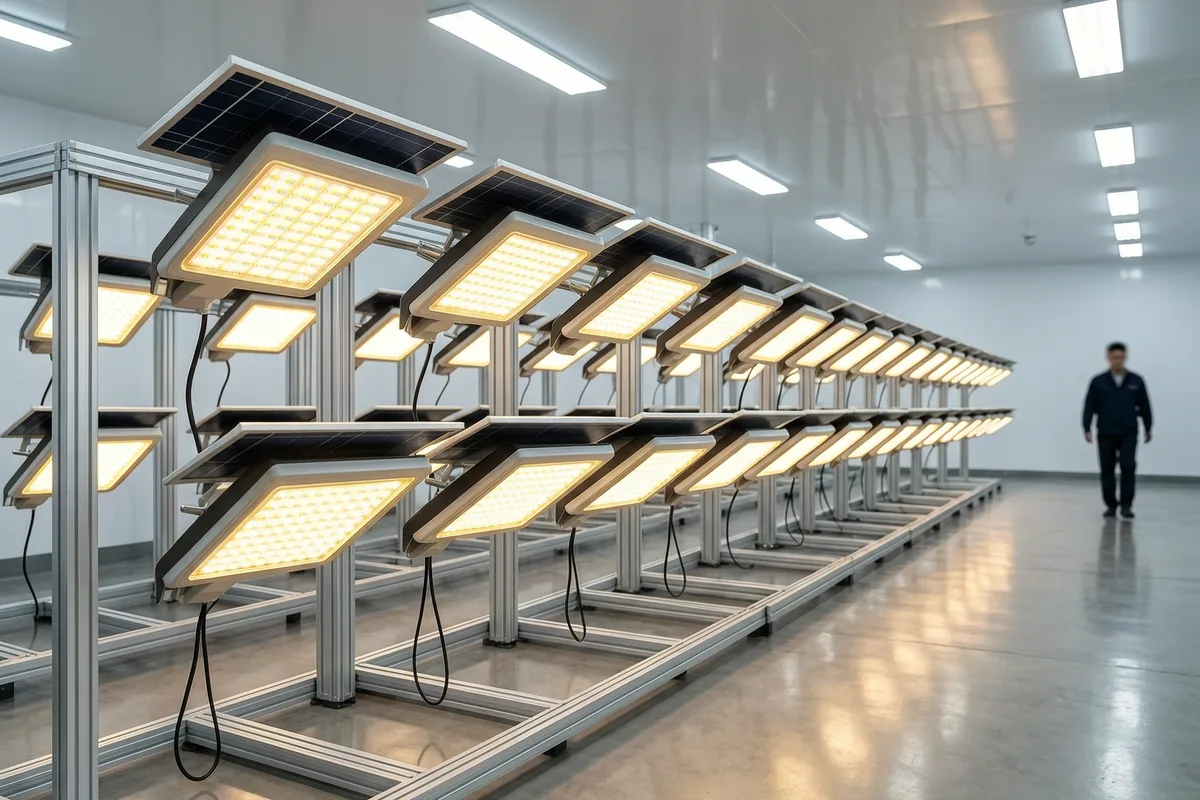
Factory audit. Ask for video or in-person access to the SMT line, assembly area, and aging room. A supplier that assembles but cannot show controlled soldering and a burn-in room is usually a trading company, not a solar street light manufacturer.
Certifications. Require CE and RoHS declarations plus component-level reports: IEC 62133-2 for the battery, IEC 60598-1 for the luminaire, and IEC 61215-1 for the panel. These are the baseline, not a differentiator.
Sample verification. Order a sample and ask for its aging-test record and photometric report. Confirm efficacy and autonomy against the datasheet.
After-sales. Get the warranty duration, covered components, and claim process in writing.
Formore's outgoing quality control (OQC) and factory-direct pages show the transparency to expect. For workflow tips when choosing a solar street light supplier china, see how to source LED lights from China.
How Do You Size a Solar Street Light for a Specific Location?
Size from site data, not from a supplier's default chart. Four inputs drive the result: peak sun hours, target daily load, required autonomy, and system derating.
- Peak sun hours (PSH). Look up your site on the Global Solar Atlas for the worst-month PSH — that is the design month.
- Daily energy load (Wh/day). LED watts × operating hours, plus controller quiescent draw.
- System efficiency. Apply a project-specific derating factor for panel soiling, temperature, and battery round-trip losses — derive it from the site survey and component datasheets rather than a round-number default.
- Autonomy. Days of no-sun backup × daily load = required usable battery Wh.
- Panel sizing. Daily load ÷ (PSH × derating) = panel W minimum.
Check the design against ANSI/IES RP-8 for the road class. Wind and pole loading also need structural checks on split systems.
OEM/ODM, MOQ, and Lead Time: What Should Buyers Ask?
Ask about tooling ownership, customization scope, MOQ per SKU, and lead time in writing — tied to a specific model. Vague answers here cause most sourcing disputes.
- Tooling ownership: Who owns the housing mold if you fund it? Put it in the contract.
- Customization scope: Logo, color, packaging, controller firmware, branding collar. Confirm what is standard vs. paid.
- MOQ per SKU: Varies by model and tooling; require a written quote per model rather than assuming a catalog default.
- Sample lead time vs. production lead time: These are two different numbers — ask for both.
- Inspection and payment: Third-party inspection option and payment milestones.
See OEM/ODM solar lighting for customization scope and China lighting sourcing for logistics.
What Are the Most Common Solar Street Light Sourcing Mistakes?
Most bad solar street light purchases are predictable. Avoid these six to cut most field failures and warranty disputes.
- Buying on price alone. Cheapest per-unit usually hides smaller batteries or thinner housings.
- Accepting unsupported lm/W claims. No photometric report means no verified efficacy.
- Ignoring battery chemistry and cycle life. Non-LiFePO4 or uncertified cells fail early in heat.
- Skipping IP and IK verification. IP65/IK08 without a test report is a label, not a rating.
- Underestimating pole and wind loading. Split systems on weak poles fail in storms.
- No local warranty support. A multi-year warranty with no regional contact is paperwork.
How to Move from Spec Sheet to Purchase Order
Convert the spec into an order in five steps: lock the configuration, verify reports, approve a sample, confirm timeline, then place a trial order.
- Lock the configuration — panel W, battery Wh, LED W, autonomy, IP/IK, controller model, pole spec.
- Collect the certificate set (IEC 62133-2, IEC 60598-1, IEC 61215-1, CE, RoHS).
- Approve a production-intent sample with its test record.
- Confirm MOQ, sample lead time, production lead time, and inspection terms in writing.
- Place a trial order before scaling.
The outdoor lighting guide covers broader project-planning context.