Human centric lighting is designed for both visual performance and the non-visual, circadian effects of light. Buyers should define the application and occupied hours first, then lock illuminance as a project target, CCT, CRI, glare control, and control strategy, and ask for spectral or melanopic data before approving samples.
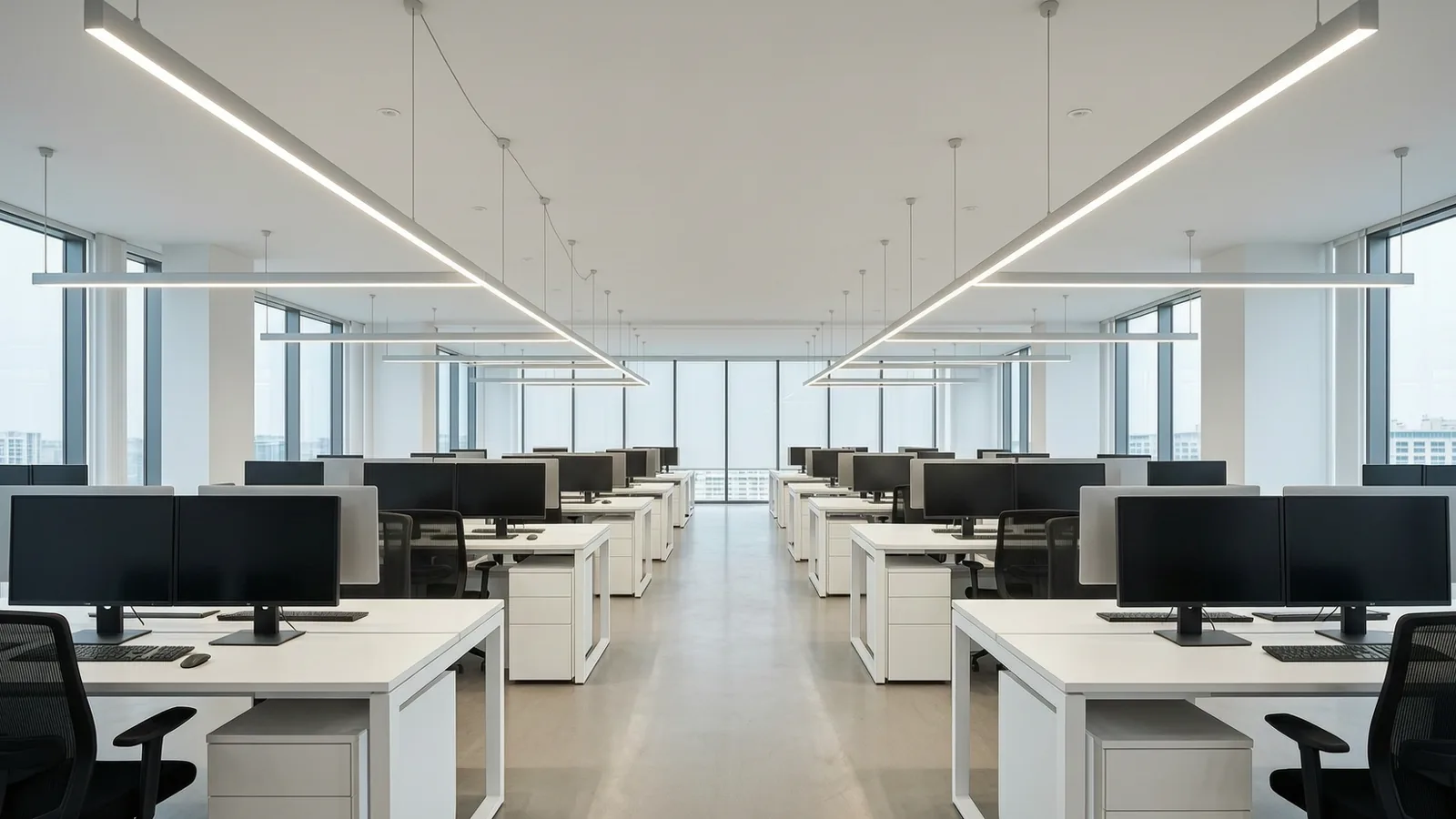
AI-generated illustration of an office lighting scene; not documentary photography of a Formore project or facility.
What is human centric lighting?
Human centric lighting is a design approach that serves visual tasks and the non-visual (ipRGC / circadian) responses to light, not a single fixture SKU or a marketing label. A credible scheme combines visual quality — illuminance, color, and glare control — with, where the client requires it, spectral or melanopic data and a time-of-day control plan.
That is a broader brief than generic “bright white office lighting,” which often chases only horizontal illuminance and a fixed CCT. The specification still has to name occupied hours and the data the supplier must provide with each shortlisted model.
Why does human centric lighting matter in commercial interiors?
Human centric lighting matters most in daytime interiors that people occupy for long periods, including offices, classrooms, and healthcare work or waiting areas. Vertical light, glare control, and color quality sit alongside any circadian intent. A scheme that ignores visual comfort will not be accepted, whatever the melanopic claim.
In office lighting design, treat comfort and any non-visual request as one coordinated brief rather than as a separate product category. For wider fixture context, see the commercial LED lighting guide; for interior and architectural adjacency, see the architectural LED lighting guide. When glare is part of the comfort discussion, use the UGR in office lighting guide instead of restating the UGR office lighting method here.
Which metrics and standards should buyers use?
Treat metrics as project requirements and reporting methods, not catalog slogans. Start with visual targets, then add non-visual data only where the client’s program requires it. Ask for files that name the exact models under review; a standard number on a brochure is not proof of performance.
Visual requirements usually include illuminance targets by zone, CCT, CRI, and glare or UGR limits. Use the color temperature guide when setting CCT. Many interiors call for a CRI 90 LED source when materials or skin tones must render faithfully; see what is CRI in lighting and CRI explained. State glare limits in the project brief rather than assuming a fixture family will meet them.
For non-visual metrology, introduce melanopic EDI only as a concept. Ask manufacturers to report melanopic or spectral data using CIE S 026/E:2018 methods, and do not invent thresholds.
For indoor workplaces, consult EN 12464-1 and the CIE/ISO Lighting of Work Places — Part 1: Indoor (ISO/CIE 8995-1:2025) as documents the project should follow for visual lighting. They are buyer references, not catalog claims.
Some clients also ask for a circadian lighting feature under the WELL Building Standard. Treat that as a market requirement to verify against the current WELL documentation. Do not invent point thresholds, and do not assume any fixture or supplier holds a WELL credential.
Request IES recommended-practice context and IES-format photometric files for every shortlisted model so distribution can be checked, not only a headline output figure.
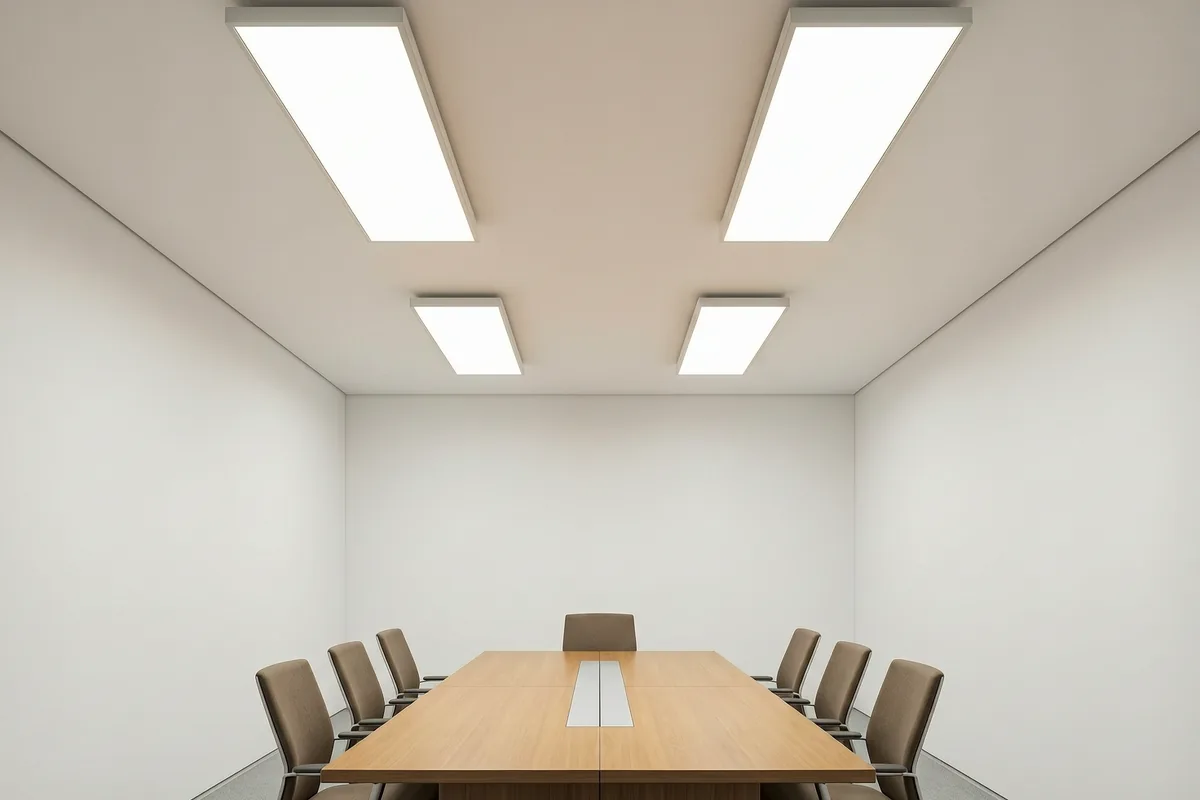
AI-generated illustration of an office lighting scene; not documentary photography of a Formore project or facility.
How do you specify human centric lighting for a project?
Start with the application, occupant tasks, and occupied hours, then write visual and control requirements before you shortlist fixtures. Daytime offices and 24-hour spaces do not share the same control plan. Specify both horizontal light and vertical illumination at the eye when non-visual intent is part of the brief, without treating either as a generic catalog value.
Set a CCT strategy next. Compare 3000K vs 4000K LED for a fixed-CCT scheme; do not retell that comparison here. Tunable-white or scheduled CCT can be specified as a project option where the control system can support it. Name the dimming or control protocol the project already uses, and check compatibility with the LED dimming guide.
Keep glare, CRI, and zone-to-zone consistency in the same specification, not as afterthoughts. The data package should include IES photometric files, plus spectral power distribution or melanopic data where the client requires it, and a structured sample review. For factory-side process questions, use the LED lighting manufacturer guide. Where downlights or accents are part of the scheme, settle distribution with the beam angle guide for commercial lighting.
Which fixture types can support a human centric lighting scheme?
No single fixture type makes a scheme “human centric.” Choose families by role — ambient, grid, circulation, or accent — then confirm photometry, controls, and, where required, spectral data. Keep CCT and CRI consistent across layers so the installation reads as one scheme.
Suspended linear fixtures are the usual ambient workhorse in open offices. A linear bar office suspended light is a typical starting point; the LED linear light guide covers system options in more depth. Linkable battens, such as a linear LED batten light (linkable), can serve back-of-house or ancillary areas.
Surface or regular-grid panels suit meeting rooms and cellular offices. Compare an ultra-slim round surface panel light with a square backlit LED surface panel, and check shielding and driver compatibility, not wattage alone.
Downlights handle circulation, perimeters, and accents. Typical options include a trimless recessed COB downlight, a classic recessed general downlight, and an adjustable gimbal LED downlight. In wet or high-rendering locations such as toilets and pantries, a high-CRI 90 waterproof LED COB downlight may be relevant; that is a product-family choice, not an HCL certification.
Track and magnetic track belong as accent layers on top of a quiet ambient scheme, not as the office workhorse. See the magnetic track lighting guide and the commercial track light guide, and consider a magnetic track light system (linear) or an anti-glare honeycomb track spotlight when beam control and glare matter.
| Fixture type | Typical role in an HCL scheme | Key specs to define | Common pitfall |
|---|---|---|---|
| Suspended linear | Ambient lighting in open offices and long work zones | Output as a project target, CCT range or tunable-white, CRI, glare control, dimming protocol | Specifying only horizontal illuminance and ignoring glare or vertical light |
| Surface / grid panels | Cellular offices, meeting rooms, regular ceiling grids | CCT, CRI, UGR or shielding, driver/control compatibility | Choosing a panel on wattage alone, with no glare or spectral data |
| Recessed or surface downlights | Circulation, perimeters, task accents | Beam angle, CCT, CRI, dimming, cut-off / glare | Over-using narrow accents as the only ambient source |
| Track / magnetic track | Accent and display layers on top of a quiet ambient scheme | Beam control, anti-glare accessories, CCT match to the ambient layer | Treating track heads as the primary office ambient system |
What should a human centric lighting specification or RFQ include?
An RFQ should turn the occupied-hours brief into testable requirements so every bidder quotes the same scope. Keep visual targets, color, glare, and controls in one document. If the client also wants spectral or melanopic data, say so explicitly, and review substitutions before sampling or production.
- Application and occupied hours.
- Visual targets by zone, stated as project requirements.
- CCT and CRI strategy, kept consistent across fixture families.
- Glare or UGR limits as project requirements.
- Control or tunable-white protocol, including driver compatibility.
- A request for spectral or melanopic data where the client requires it.
- Destination-market documents the client follows, such as EN 12464-1, ISO/CIE 8995-1, and/or a WELL circadian lighting feature, if applicable.
- Sample and photometric-file requests for each shortlisted optic.
- Batch-consistency and inspection plans.
- OEM/ODM needs if a custom finish or control interface is required — see OEM/ODM lighting services.
Review project cases for application context, and browse commercial LED lighting products when you are ready to shortlist families.