Architectural LED lighting uses fixtures to reveal a building's form, materials, and circulation rather than only filling a space with light. Buyers should choose fixture types by application (facade, landscape, interior accent), then lock beam angle, CCT, CRI, IP rating, and glare control in the specification before asking an architectural lighting supplier for samples and photometric files.
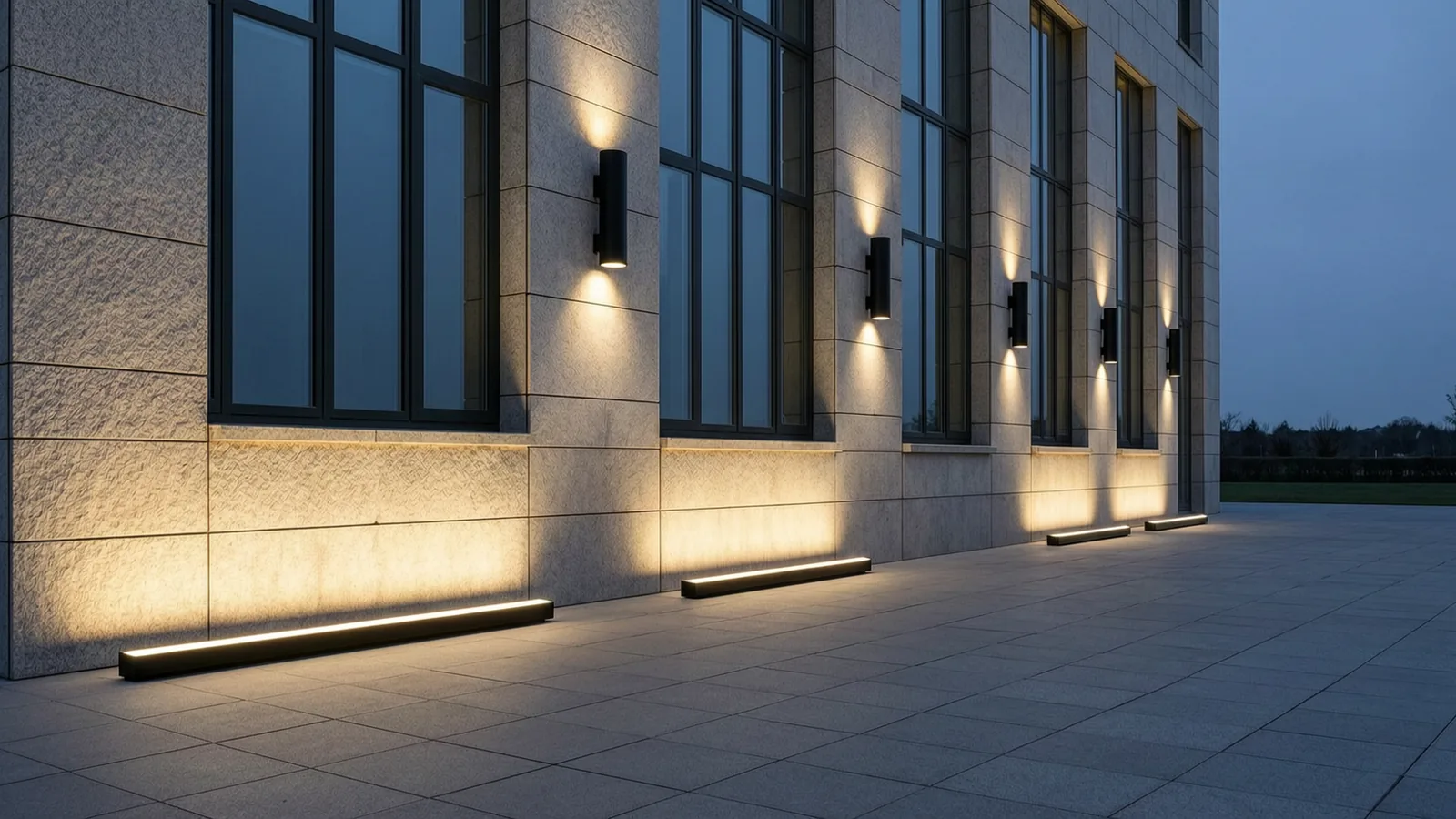
AI-generated illustration of an architectural lighting scene; not documentary photography of a Formore project or facility.
What is architectural LED lighting?
Architectural LED lighting expresses a building's form, texture, rhythm, and circulation through deliberate placement and optical control. Ambient lighting provides general visibility; architectural lighting emphasizes selected surfaces and details. Define the intended effect and integration needs before selecting fixtures.
Organize the specification around facade/exterior, landscape/site, and interior accents. Coordinate finishes and color across zones, but treat mounting and environmental provisions separately. For broader commercial applications, use the commercial LED lighting guide; this guide focuses on architectural selection and procurement.
Which fixture types are used in architectural LED lighting?
Choose fixture families by the surface or route they serve, then check mounting against the architecture. A wall washer, path bollard, and recessed guide light solve different problems. Record intended function with the model so substitutions preserve the design, not only appearance.
Facade and exterior. Consider a linear LED outdoor wall washer for continuous wash, an up/down architectural wall sconce for repeated vertical accents, or an adjustable-head outdoor wall spotlight for a selected feature. A decorative facade wall sconce adds a visible architectural element—approve nighttime pattern and daytime finish.
Landscape and site. An adjustable beam in-ground uplight or IP67 in-ground well light can handle feature lighting when installation conditions allow. Compare a minimalist architectural garden bollard for paths with a precision aluminum spike spotlight for planting accents, and confirm shielding plus maintenance access.
Interior integration. Coordinate a recessed step light, linear slot recessed wall light, or trimless recessed COB downlight with wall and ceiling construction. For adjustable accents, use the magnetic track lighting guide and commercial track light guide rather than treating track heads as fixed downlights.
| Application | Typical fixtures | Key specs to define | Common pitfall |
|---|---|---|---|
| Facade / exterior | Wall washers, up/down sconces, wall spotlights | Beam distribution, IP/IK rating, CCT consistency across runs | Uneven washing or hot spots from wrong beam/offset |
| Landscape / site | In-ground uplights, bollards, spike spotlights | IP rating for burial/wet locations, glare shielding, adjustability | Glare into walkways, water ingress |
| Interior accent | Recessed step/guide lights, linear slot, trimless downlights, track | CRI, UGR/glare control, dimming, finish integration | Mixed CCT between fixture families |
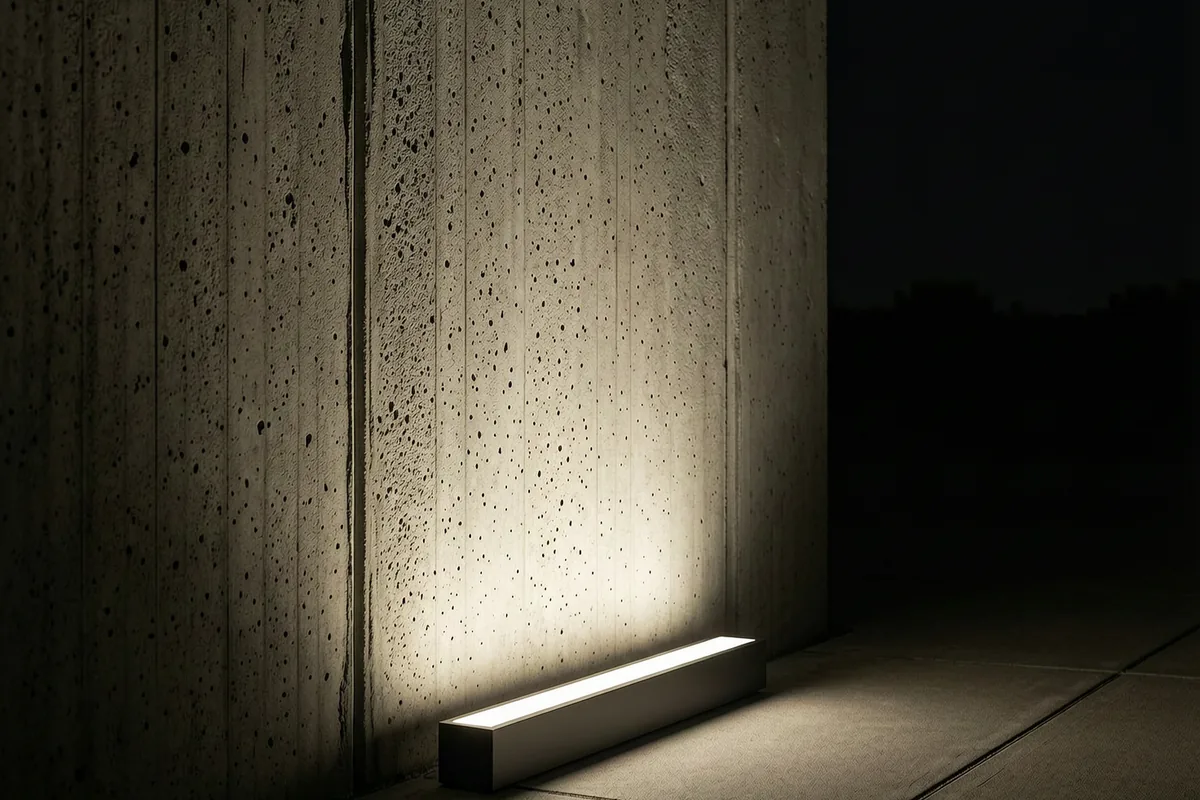
AI-generated illustration of an architectural lighting scene; not documentary photography of a Formore project or facility.
How do beam angle, CCT, and CRI shape architectural results?
Beam distribution controls where light falls; CCT describes apparent warmth; CRI helps assess material rendering. Specify them together and review on the actual stone, wood, or paint. A catalog match alone does not prove fixture families will look consistent when installed together.
For beam angle lighting decisions, narrow distributions suit accents or grazing; wider or asymmetric optics suit washing. Offset and aiming matter too—use the beam angle guide for commercial lighting and verify with photometry plus a mock-up.
Compare 3000K vs 4000K LED against material samples; the color temperature guide gives broader context. The CIE definition of CRI relates rendering to a reference illuminant. Higher CRI usually supports material fidelity, but sample approval still matters—see what is CRI in lighting.
For interiors, assess glare in the layout using UGR office lighting explained; a fixture label alone is insufficient. Human-centric lighting may appear in an emerging interior brief; procurement still needs defined controls and acceptance criteria.
What durability and compliance specs matter outdoors?
Outdoor suitability depends on enclosure protection, impact resistance, materials, and installation details together. IP covers ingress protection; IK covers mechanical impact. For in-ground fixtures, neither a product name nor an IP rating alone proves burial or standing-water suitability—confirm drainage and the manufacturer's installation conditions.
Request enclosure evidence against IEC 60529, plus corrosion, sealing, cable-entry, and service-access details for the site. For luminaire safety, request exact-model reports against applicable IEC 60598 requirements and destination-market approvals. Citing a standard is not proof of certification.
Obtain IES-format photometric files for every selected optic so the designer can model distribution and spill. Confirm drivers, control interfaces, and dimming behavior together using the LED dimming guide.
The DarkSky and IES outdoor-lighting principles call for useful, targeted, controlled light at appropriate levels and warmer colors where possible. Specify shielding, careful aiming, and schedules. Where uplights are proposed, check local rules and keep beams on the intended surface.
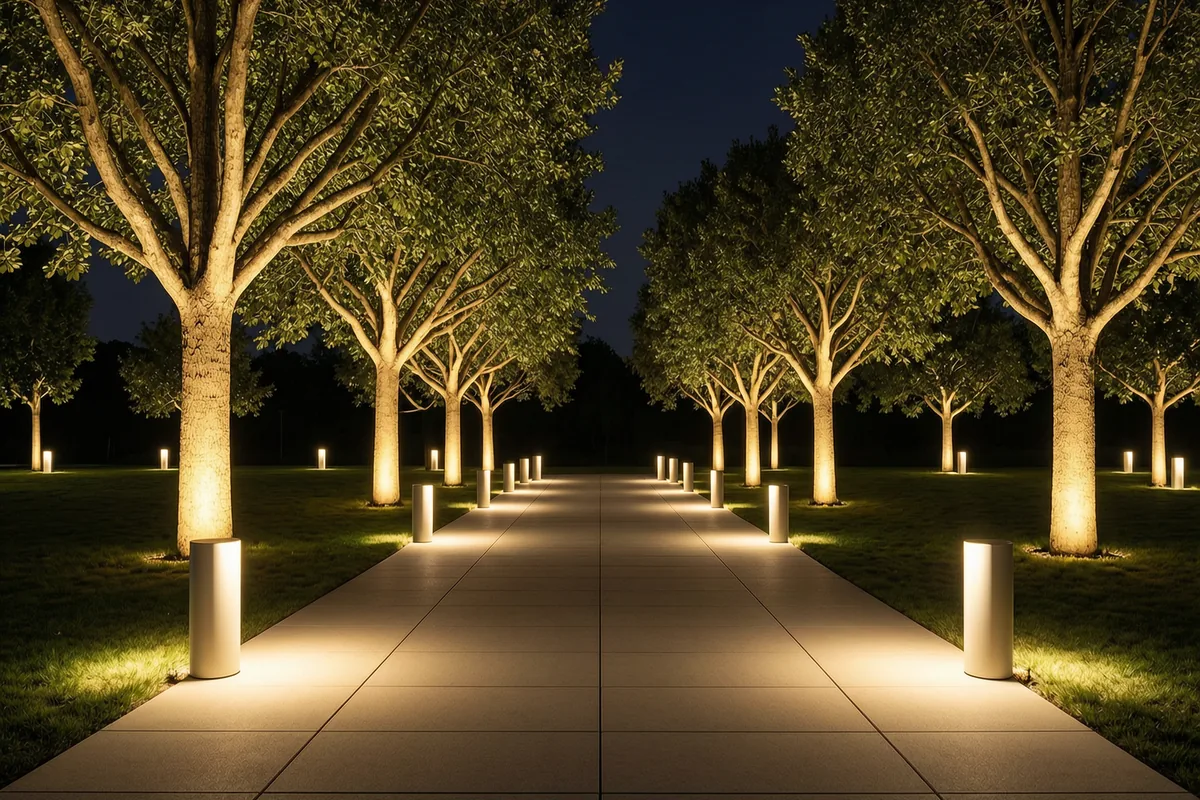
AI-generated illustration of an architectural lighting scene; not documentary photography of a Formore project or facility.
How do you vet an architectural lighting supplier?
Evaluate an architectural lighting supplier against the full fixture schedule, not one sample. Require category fit, matching photometric files, a documented sample process, and batch control of finish and CCT. Ask how substitutions are approved and how inspection records tie deliveries to the approved specification.
Use this checklist when assessing an LED lighting manufacturer in China:
- Compare capabilities with the LED lighting manufacturer guide and factory-first manufacturing.
- Review component verification through incoming quality control and shipment acceptance through outgoing quality control.
- Establish design and tooling responsibilities using the OEM vs ODM lighting guide and OEM/ODM lighting services.
- For broader due diligence, consult how to source LED lights from China and China lighting sourcing.
What should an architectural lighting RFQ include?
An RFQ should turn architectural intent into testable requirements for each zone. Give every bidder the same drawings, fixture schedule, and approval criteria so quotes cover comparable scope. Keep options separate from confirmed requirements, and review substitutions before samples or production.
- Drawings or renderings, fixture schedule, and zone references.
- Beam distribution, CCT, CRI, and glare criteria.
- IP/IK needs and site exposure conditions.
- Finish or RAL color, mounting, and access details.
- Dimming protocol, driver location, and control interfaces.
- Destination-market safety documentation and applicable standards.
- Sample and mock-up plan, packaging, and labeling.
- Inspection criteria, change control, and Incoterms.
Review project cases and lighting solutions for application context; a commercial lighting solution provider can help coordinate mixed-zone requirements. Approve the nighttime mock-up and record the accepted configuration before ordering.