Retail lighting design is a merchandising and specification process, not just a fixture purchase. It layers ambient, accent, and display light across store zones, ties each layer to visual comfort and color quality metrics, and defines fixture schedules for consistent multi-store rollouts.
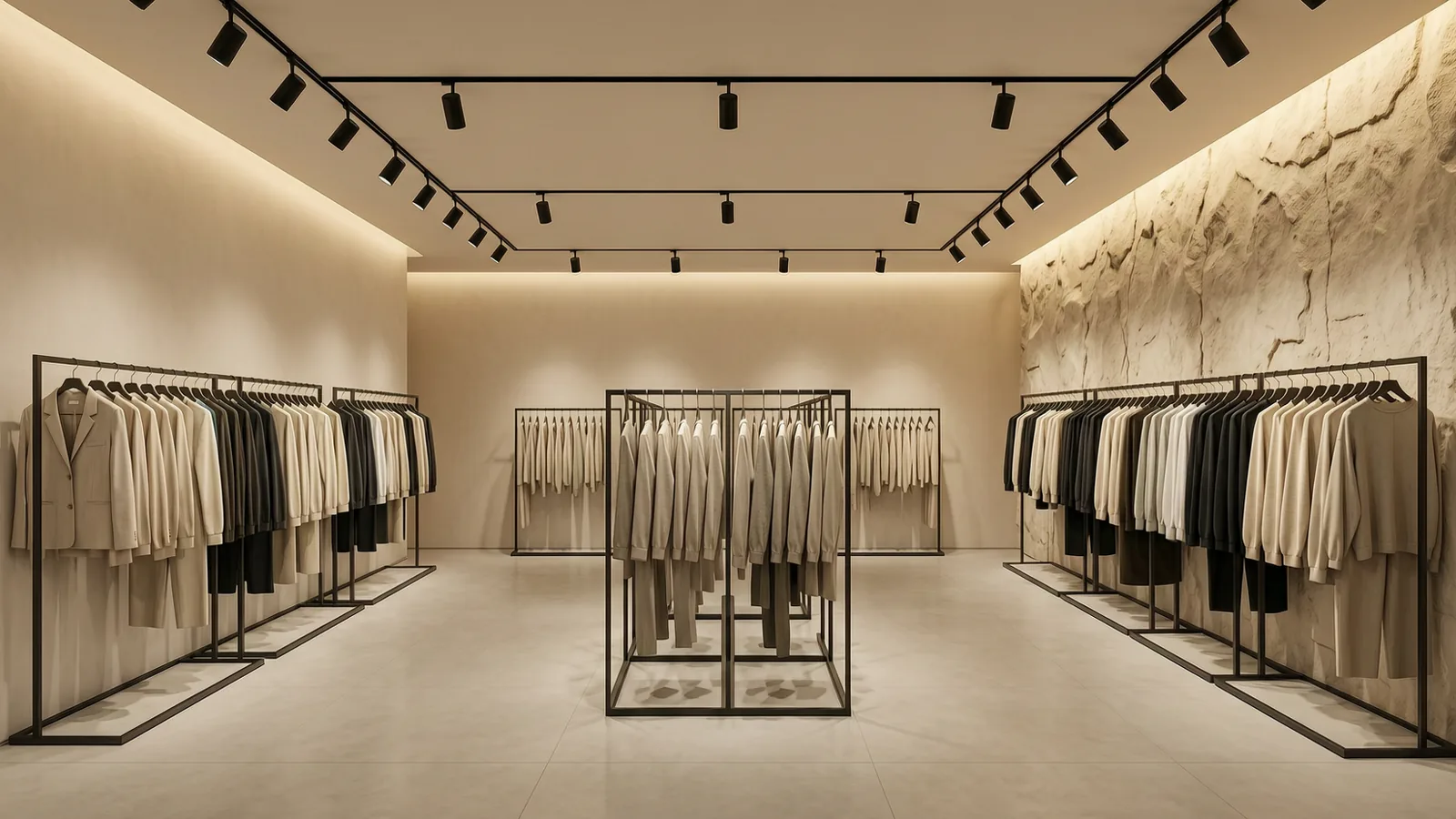
AI-generated illustration of a retail lighting scene; not documentary photography of a Formore project or facility.
What is retail lighting design?
Retail lighting design is a merchandising and specification process: it layers ambient, accent, display or shelf, and facade or window light across store zones, then ties each layer to visual comfort, color quality, and a fixture schedule. It is not the act of buying one fixture for an entire shop.
The specification should describe how merchandise is seen, how shoppers move, and what evidence a supplier must submit. Ambient light supports navigation, accent marks features, display and shelf light presents product, and facade light addresses the street.
This article is the design and specification guide. Technical deep-dives on track systems, beam angle, color, and controls are linked rather than repeated, so the RFQ can stay focused on zones, layers, and files a B2B buyer can verify.
Why does lighting matter in a retail store?
Lighting matters in a retail store because merchandising, shopper visual comfort, and brand perception all depend on how clearly products and routes are seen. A floor that looks consistent on a drawing can still feel uneven if accent, color, or glare drift from zone to zone. Buyers should specify those conditions in writing, not leave them to a catalog default.
Zoning consistency also matters when the same concept is rolled out to more than one location. The same visual language should be repeatable, with a controls plan that can support day, evening, and closed-store scenes.
Treat sales impact as a merchandising goal, not as a promised percentage. Visual comfort also includes glare along the path, especially where shoppers pause at feature displays or the cash wrap. The same zoning discipline appears in hotel lighting design, but this guide stays on stores. For fixture-family context beyond retail, see commercial LED lighting.
Which lighting layers does a retail store need?
A complete retail scheme usually needs four layers, even if some rooms combine roles in one fixture family. Ambient light helps shoppers navigate. Accent light highlights features. Display and shelf light presents merchandise at close range. Facade and window light create street appeal. Write each layer into the schedule so substitutions cannot flatten the design.
Contrast between accent and ambient should be described qualitatively. Higher contrast draws the eye to feature walls and focal displays; a closer balance keeps the main floor even and comfortable. Do not treat a numeric ratio as a universal rule.
Track systems help when merchandising changes often, because heads can be moved, re-aimed, or swapped without rebuilding the ceiling. Staff and back-of-house rooms still need a quieter, more uniform layer; consult EN 12464-1 for those indoor workplace references. If offices sit behind the selling floor, use the office lighting design guide rather than stretching the retail brief.
How do beam angle, CRI and color temperature affect merchandise?
Beam distribution, color rendering, and CCT decide how merchandise is seen, so they belong in the same brief as the fixture type. Narrow distributions can concentrate light on small, high-value pieces such as jewelry or art, while wider distributions can cover apparel racks more evenly.
Confirm the choice with photometry and a sample, using the beam angle guide for commercial lighting and beam angle secrets.
Color quality matters for food, apparel, and cosmetics because shoppers judge finish, freshness, and hue under the installed light. Many retail briefs specify a CRI 90 LED source for those categories; see What Is CRI in Lighting? and CRI explained. For metric definitions, consult CIE 13.3 or the CIE 2017 Colour Fidelity Index (CIE 224:2017). Do not invent a rendering score as a house rule.
CCT should follow brand identity and zone intent, and stay consistent unless a change is deliberate. Compare 3000K vs 4000K for a fixed-CCT choice, and use the color temperature guide for broader context. Consult IES RP-2, Lighting Retail Spaces, for retail lighting practice; treat it as a reference, not as a Formore claim.
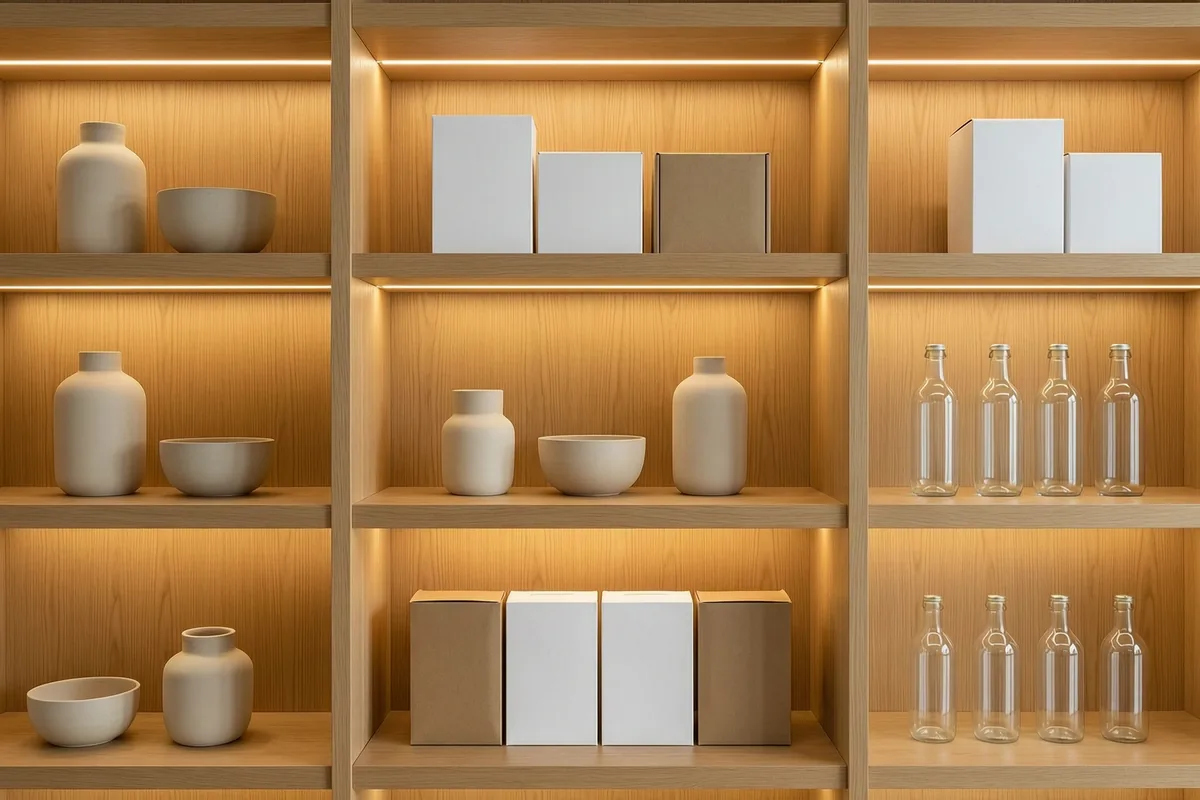
AI-generated illustration of a retail lighting scene; not documentary photography of a Formore project or facility.
How should lighting change by store zone?
Lighting should change with the merchandising task, the shopper path, and how long people pause in each area. A window, a main aisle, a fitting room, and a stockroom are different zones. Write those differences into the fixture schedule so one default package cannot be applied to every room.
Window and facade displays need adjustable spots and a clear contrast with the street so the composition can be read from outside. The entrance or decompression zone is a transition: it can feel slightly more open than the deep store, without a sudden jump in glare. The main floor needs balanced ambient light plus flexible accent that can be re-aimed when layouts change.
Feature displays and walls can use a higher accent-to-ambient contrast so focal merchandise stands apart. Fitting rooms need flattering, glare-free, high-CRI front-lighting. The cash wrap should be task-focused and comfortable. Back-of-house rooms should be functional and uniform.
Address glare and visual comfort throughout the public path. For glare language used in workplace interiors, see UGR office lighting explained; set any limit from the project standard, not from a supplier rule.
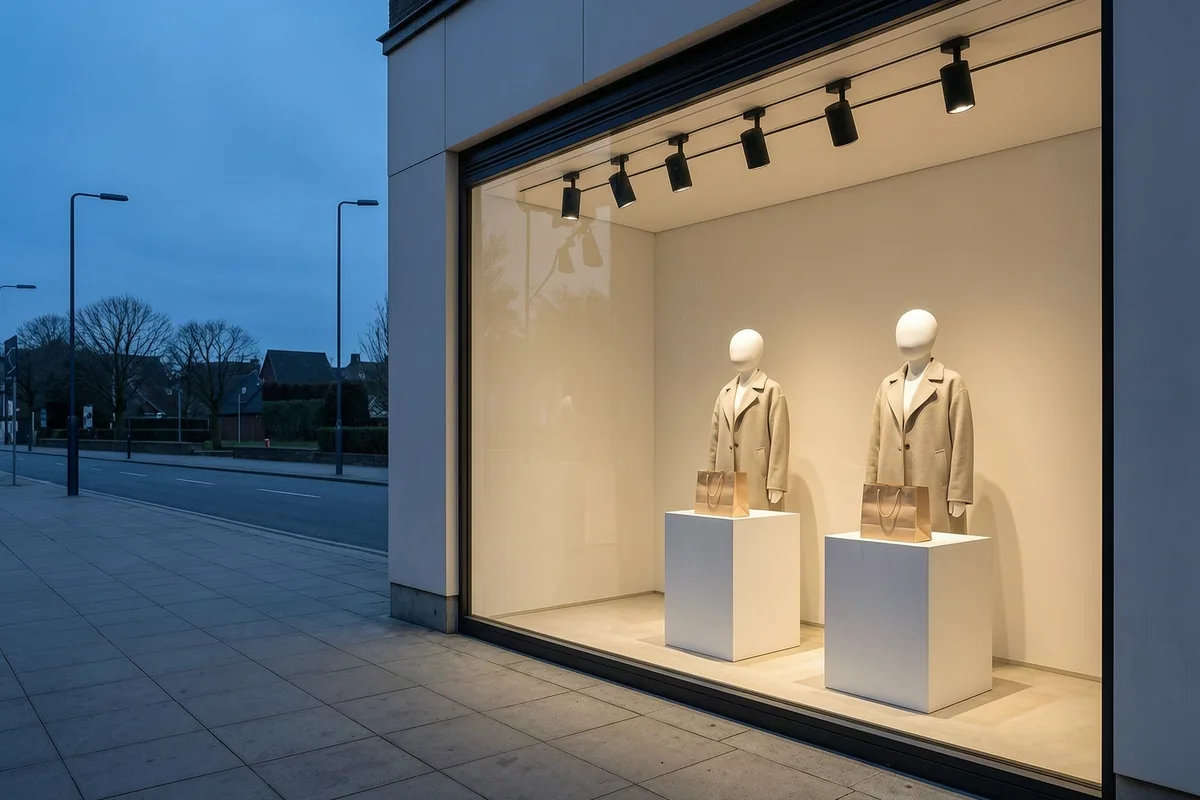
AI-generated illustration of a retail lighting scene; not documentary photography of a Formore project or facility.
Which fixture types belong in a retail lighting plan?
Choose fixture types by layer and zone, then confirm photometry, color, glare control, and aiming before you lock the schedule. A clear family-to-zone map makes later substitutions easier to judge. Do not select a workhorse fixture from wattage or appearance alone.
Track spots and magnetic systems carry most of the flexible accent layer. Start with the commercial track light guide and the magnetic track lighting guide, and ask a track light system supplier to submit matching rails, heads, and photometric files. Typical heads include a high power 40W retail track light, a commercial COB track spotlight 30W, a cylindrical COB commercial track head, a zoomable focusing LED track light, and an anti-glare honeycomb track spotlight. Magnetic options include a magnetic track light system linear and a magnetic track spotlight module.
Recessed adjustable or gimbal downlights provide a cleaner ambient or accent ceiling. Consider a trimless recessed COB downlight, an adjustable gimbal LED downlight, or a mini adjustable ceiling spotlight. For shelf presentation, a commercial 24V COB LED strip high CRI can form the display layer. Pendants, such as a modern minimalist ring pendant light, suit feature zones. Perimeter and detail conditions are covered in architectural LED lighting.
How do you keep lighting consistent across a multi-store rollout?
Consistency across locations depends on a locked fixture schedule, not on a similar-looking substitute at each site. Specify the same SKU, strict LED binning, and matching photometric files for every store, then review physical samples against that approved package before rollout.
Ask the factory how binning, finish, and optics are held from batch to batch. Use the LED lighting manufacturer guide for the factory-side process, and the OEM vs ODM lighting guide when branding or private-label packaging is required. Keep approved samples as the reference for later deliveries.
What should a retail lighting RFQ include?
An RFQ should turn the merchandising plan into testable requirements so every bidder quotes the same scope. List zones and display intent first, then attach visual targets, controls, and the evidence you will review. Keep substitutions subject to technical review before sampling or production.
- Application and zones: floor plans, zone types, and merchandising goals.
- Visual targets: qualitative contrast goals, CCT and CRI requirements, and glare limits from the project standard.
- Controls: dimming protocol, scenes, and sensors. Confirm compatibility with the dimming guide.
- Photometric files: IES or LM reports for every SKU submitted.
- Sample review, LED binning, and consistency checks across the fixture schedule.
- OEM or custom-interface needs, if required — see OEM/ODM.
Review cases for application context, and browse products when you are ready to shortlist families.