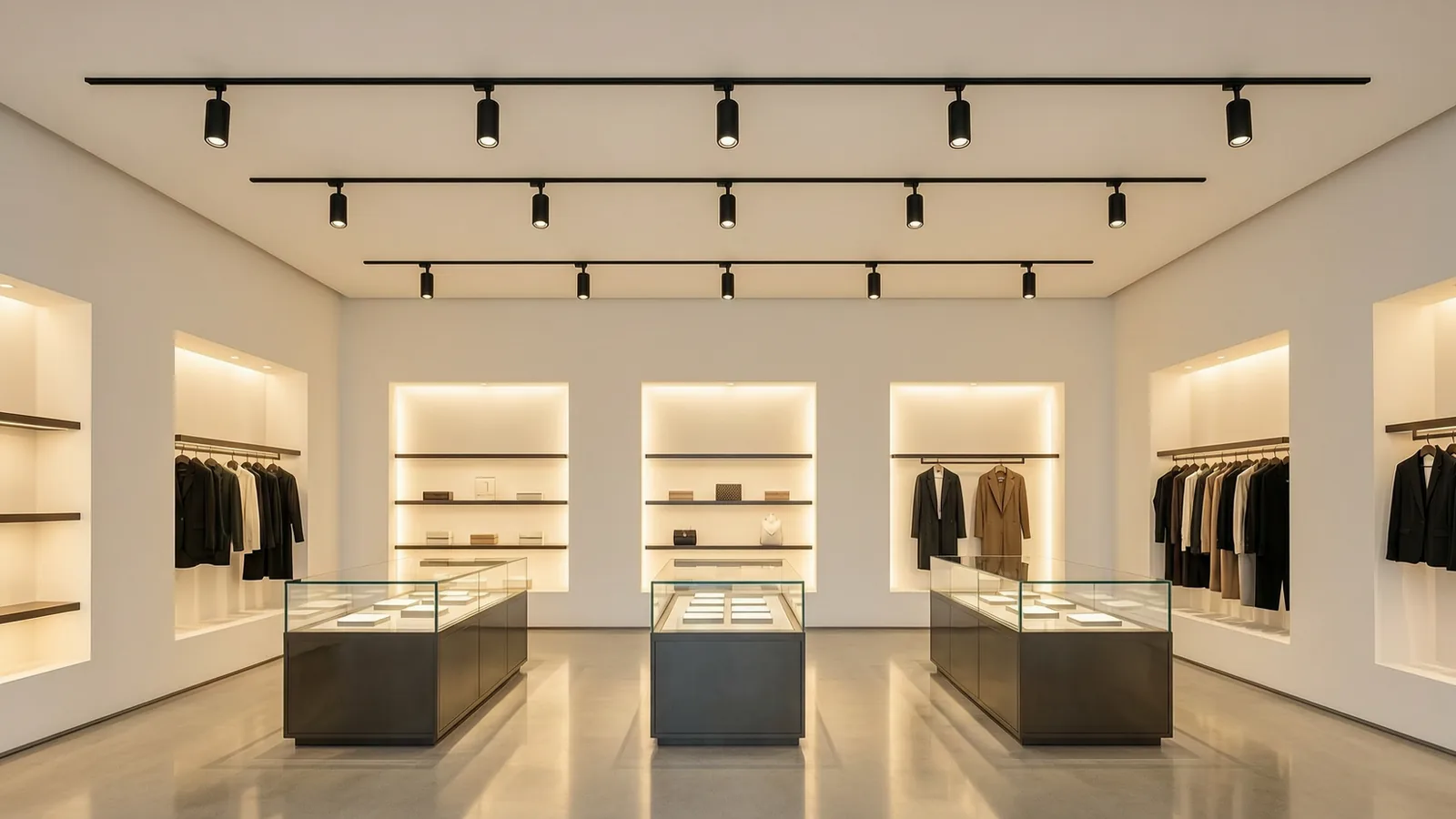
A commercial track light is a modular accent and general lighting system for retail and commercial interiors. Buyers choose among traditional track, magnetic track, or recessed slot systems based on flexibility, aesthetics, and installation constraints. This guide helps B2B buyers specify, compare, and source the right commercial track lighting without reinventing a full magnetic-track deep dive.
What is a commercial track light and when do you use it?
A commercial track light is a luminaire that mounts on a continuous powered rail, so heads can be added, moved, re-aimed, or removed without rewiring the ceiling. The same rail can carry accent spotlights and general-purpose modules, which makes commercial track lighting a flexible layer in changing interiors.
Typical use cases include retail stores, art galleries, showrooms, and hospitality spaces such as lobbies and restaurants. Illuminating Engineering Society (IES) retail and accent-lighting guidance treats adjustable accent light as a core tool for directing attention, and track is one of the most practical ways to deliver it. When a tenant changes or a display is reworked, the rail stays and only the heads change. For broader context across fixture families, see the commercial LED lighting guide.
How do traditional track, magnetic track, and recessed slot systems compare?
The three common architectural track types differ in look, flexibility, and how early they must be coordinated with the ceiling. Traditional line-voltage track suits robust, industrial, or classic retail looks. Magnetic track supports tool-free module swaps and a slim profile. Recessed slot or channel systems sit nearly flush for minimal ceilings.
| Criterion | Traditional track | Magnetic track | Recessed slot / channel |
|---|---|---|---|
| Look | Visible rail; industrial or classic retail | Slim rail; cleaner architectural look | Nearly flush; minimal ceiling presence |
| Flexibility | Heads slide/aim on rail; familiar install | Tool-light module swaps; mixed spot + linear | Modules in a continuous architectural channel |
| Typical spaces | Retail, galleries, showrooms | Boutiques, offices, hospitality feature zones | High-end retail, museums, clean ceilings |
| Install notes | Surface or pendant rail common | Often low-voltage magnetic systems | Needs ceiling coordination early |
This guide stays at the selection level. For a full look at magnetic hardware, drivers, and module types, read the magnetic track lighting guide; for linear modules that run inside magnetic or slot systems, see the LED linear light guide.
Why is commercial track lighting favored for retail and showrooms?
Retail and showroom layouts change with seasons, promotions, and product launches. Track lets store teams re-aim heads to follow new displays instead of calling in an electrician each time, which keeps visual merchandising agile.
Good retail schemes are layered: ambient light for circulation, then accent light to make key merchandise stand out. Adjustable heads bring out texture, finish, and color on products. Beam choice matters here—narrow spots for focal displays, wider floods for wall bays—so use the beam angle guide for commercial lighting when planning optics.
Color rendering is equally important. The CIE color rendering method underpins the CRI values on spec sheets, and higher-CRI sources help merchandise look accurate. For accent heads, a commercial COB track spotlight 30W or a high power 40W retail track light are typical starting points.
How do COB track spotlights and linear track modules work together?
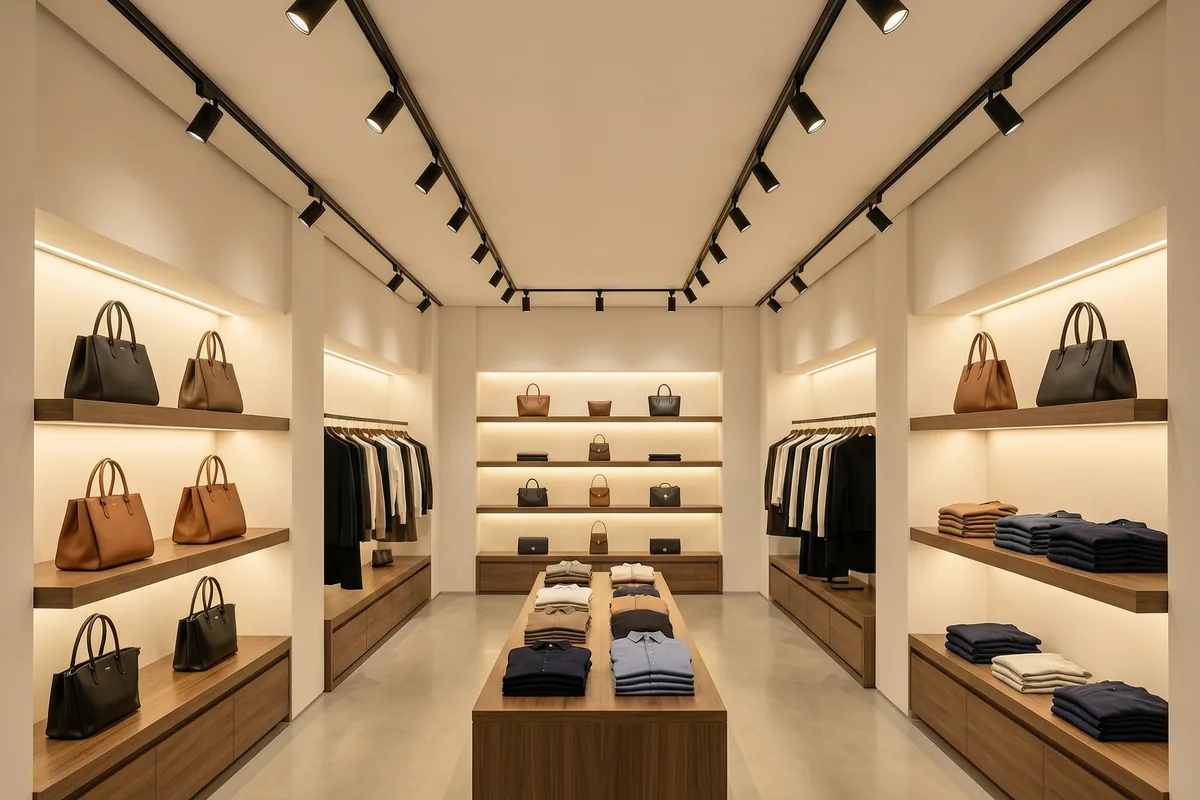
COB spotlights deliver focused beams for accent, while linear modules spread light evenly for wall washing or ambient fill. Mixing both on one track gives a balanced design: displays get emphasis, and walkways do not feel dark or flat.
Accent heads can include the commercial COB track spotlight 30W, the high power 40W retail track light, or a cylindrical COB commercial track head for a cleaner silhouette. On magnetic rails, a magnetic track light system linear can provide the ambient layer next to a magnetic track spotlight module. Where shoppers look up toward heads, an anti-glare honeycomb track spotlight helps control glare.
Which optical and color specs matter (beam, CRI, CCT, glare)?
Four optical specs decide whether a commercial track light performs in the space:
- Beam angle. Narrow beams for accent, wider beams for general light. A zoomable focusing LED track light lets one head cover different display sizes.
- CRI. Color rendering determines how true merchandise looks; see what is CRI in lighting.
- CCT. Match color temperature to brand and space. The CIE defines correlated color temperature; for the commercial choice, read 3000K vs 4000K LED, and for wider context, the color temperature guide.
- Glare. Use deep-set optics, snoots, or honeycomb louvers where heads sit in sightlines.
Programs such as ENERGY STAR publish color-consistency expectations for certified products, a useful reference when writing color tolerance into a spec.
When should you choose magnetic track over traditional track?
Choose magnetic track when the design calls for a slim profile, tool-free swaps, and a mix of spot and linear modules on one rail. Its low-voltage operation is a practical advantage when heads are moved often, and modules can be added later without replacing the rail.
Choose traditional track for high-output, heavy-duty heads, for classic or industrial aesthetics, or when the project already has line-voltage track in place. In either case, confirm dimming compatibility early—magnetic systems depend on the driver and protocol, so check the dimming guide before you lock the spec.
What belongs in an RFQ when sourcing a track light system supplier?
A clear RFQ reduces back-and-forth with any track light system supplier. Include:
- Track type (traditional, magnetic, recessed slot) and voltage.
- Finishes and rail lengths, plus connectors, end caps, and feeds.
- Luminaire specs: CRI, CCT, beam angle, and quantities per type.
- Dimming protocol and driver location.
- Requests for CAD files, IES photometric files, and compliance documents such as IEC 60598 or UL 1598 test reports for the exact SKUs.
For process advice, see how to source LED lights from China and the OEM vs ODM lighting guide. Formore's China lighting sourcing and OEM/ODM lighting services pages explain how custom finishes or private-label heads can be scoped.
What mistakes delay commercial track light projects?
- Mismatched adapters between rail and heads from different systems.
- Wrong voltage assumptions between track, drivers, and luminaires.
- Late ceiling coordination for recessed slot channels.
- Ignoring dimming compatibility until commissioning.
- Skipping samples, so finish or optical issues appear only at installation.
Coordinate early with electrical contractors and ceiling planners. Consistent quality control at the factory also limits defective batches; see factory-first manufacturing for how that process is presented.
How do you move from track specification to sample and order?
Follow a simple workflow: specification, sample approval, pilot install, then bulk order. When samples arrive, check build quality, finish consistency, connector fit, and optical performance in a project-like setting. For multi-zone or mixed-system projects, a commercial lighting solution provider can coordinate layouts, and our lighting solutions page shows typical applications. When you are ready, contact Formore or browse commercial LED products.