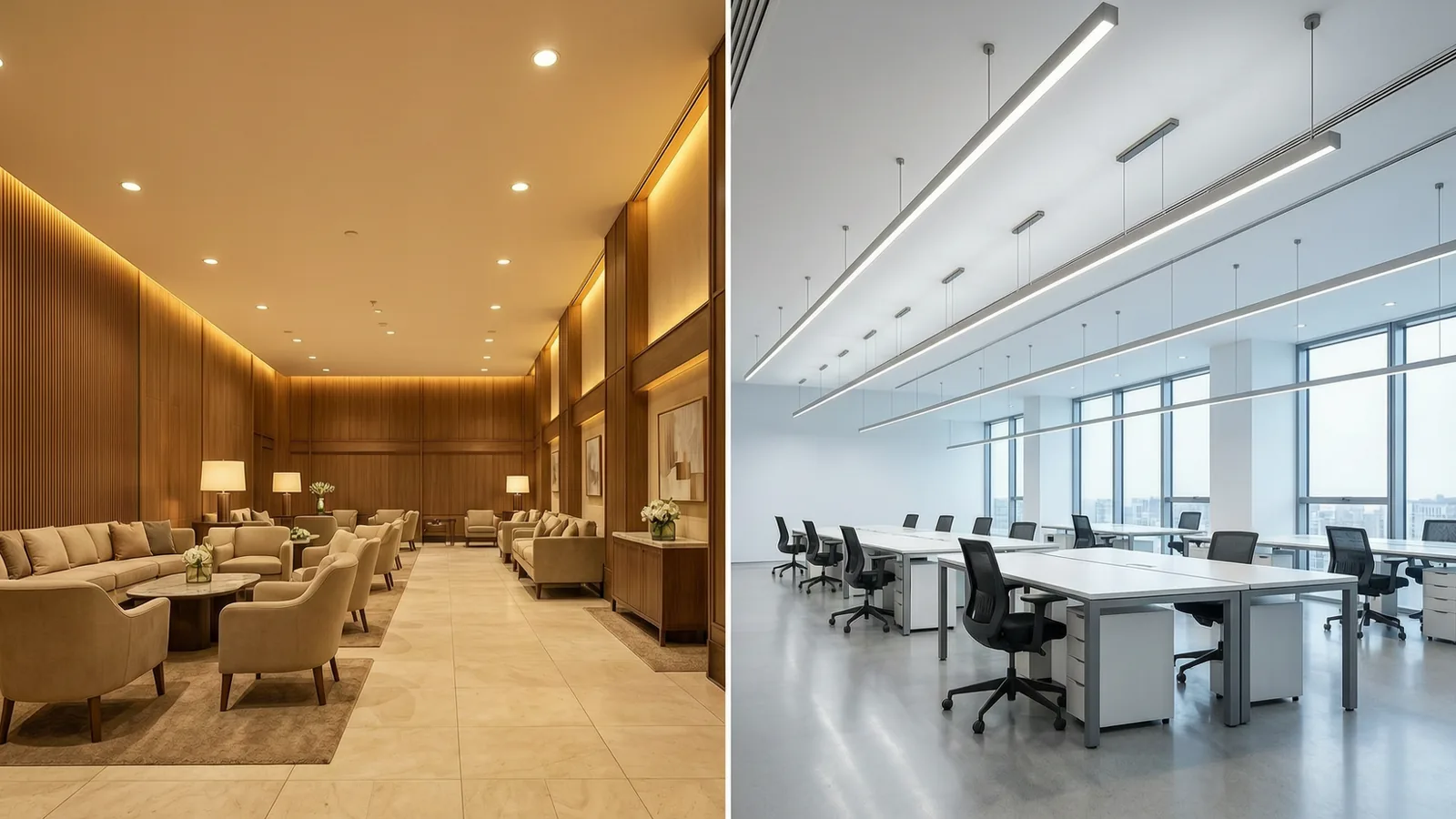
Choosing between 3000K and 4000K LED lighting shapes how a commercial space feels and performs. Warm 3000K suits hospitality and retail ambiance; neutral 4000K supports focus in offices and task areas. This guide compares both for B2B decisions and points to the broader color temperature guide for full Kelvin context.
What is the core difference between 3000K and 4000K LED?
The core difference is visual warmth. Correlated color temperature (CCT) describes how warm or cool a white light source appears, as defined in the CIE International Lighting Vocabulary. In trade terms, 3000K is usually sold as warm white and 4000K as neutral or cool white—so the 3000k vs 4000k choice is really a warm white vs cool white LED decision.
This article stays on that commercial decision. For the wider Kelvin scale, read the color temperature guide; for application context across fixture families, see the commercial LED lighting guide. If an acronym on a cut sheet is unfamiliar, the LED terminology guide gives a quick gloss.
How do 3000K and 4000K compare side-by-side for commercial use?
Neither CCT is “better.” Each supports a different design intent, and the right answer depends on what occupants do in the space. Use the conceptual comparison below as a starting point, then confirm with samples.
| Criterion | 3000K (warm white) | 4000K (neutral / cool white) |
|---|---|---|
| Feel / ambiance | Cozy, inviting, relaxed | Crisp, alert, professional |
| Typical spaces | Hospitality, retail accent, lobbies | Offices, meeting rooms, task areas |
| Warm white vs cool white framing | Often labeled warm white | Often labeled neutral or cool white |
| Visual comfort notes | Softens atmosphere in guest-facing zones | Supports contrast for detailed visual tasks |
Interior materials also matter. Warm wood, fabric, and brass finishes tend to read richer under 3000K, while white, gray, and glass-heavy interiors often look cleaner under 4000K. Review finishes, not just the floor plan.
When should you specify 4000K for office lighting?
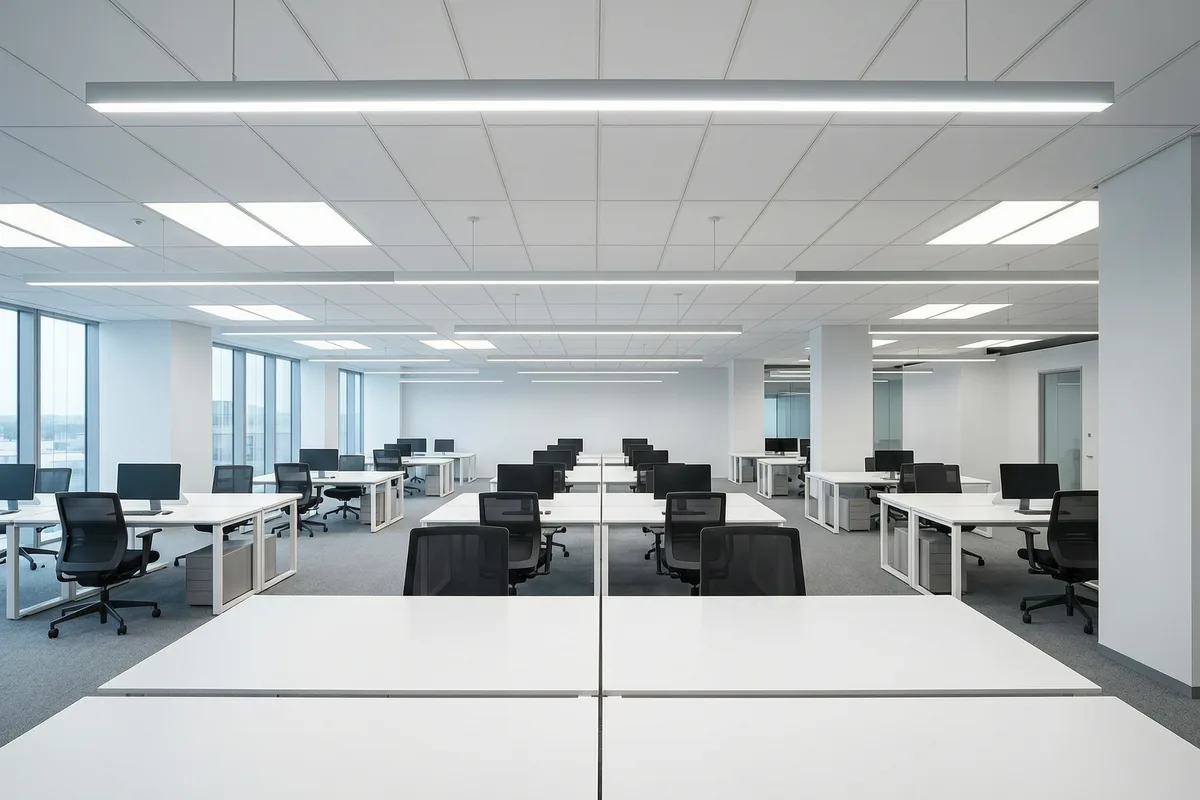
Specify 4000K office lighting where the main activity is task-oriented: open-plan desks, meeting rooms, training rooms, and areas with screen work or document review. Neutral white reads crisp and professional and supports a clear, alert working atmosphere.
CCT is only one part of office comfort. Workplace guidance from the Illuminating Engineering Society treats light quality as a combination of illuminance, glare, and color, so pair the 4000K decision with glare control—see UGR office lighting explained. Fixture choice follows from that: a linear bar office suspended light suits continuous rows over workstations, and an ultra-slim round surface panel light works where ceilings cannot take recessed housings.
Break rooms and wellness spaces in the same office do not have to follow suit. Many designers move those zones to a warmer CCT; see the mixing section below.
Why choose 3000K LED lighting for retail and hospitality?
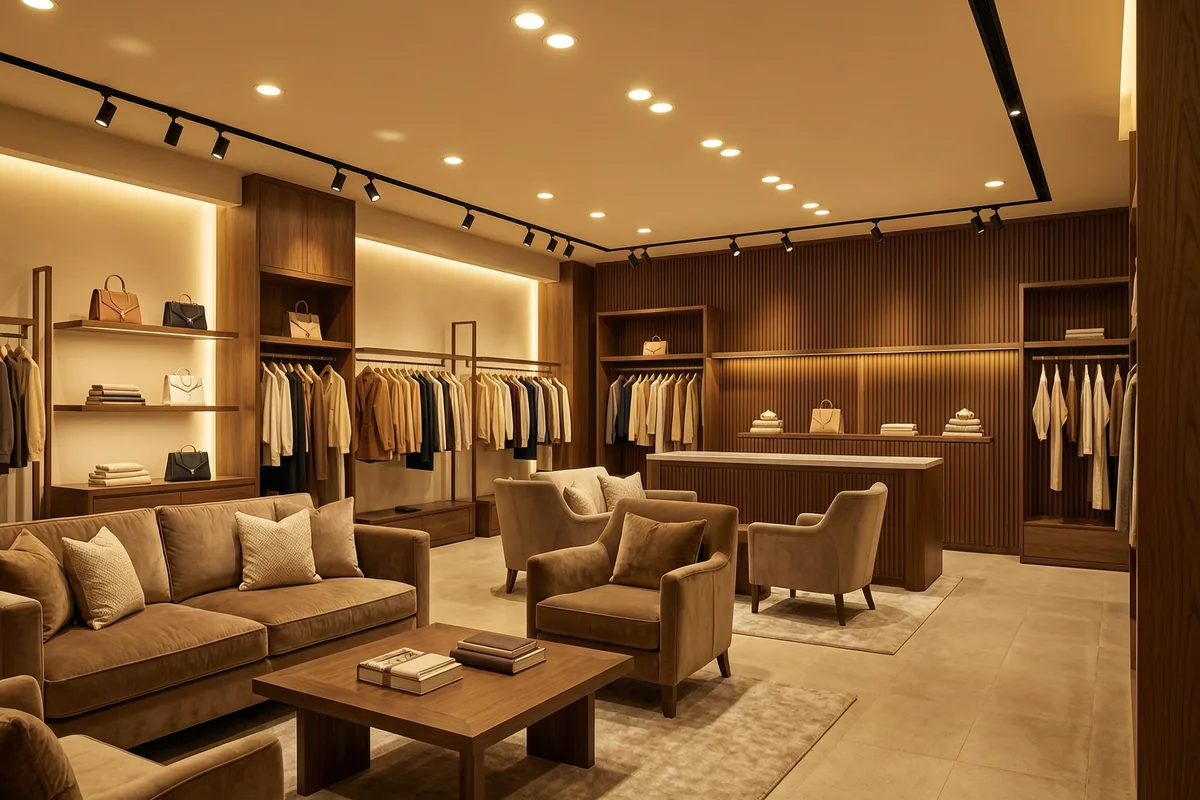
3000K LED lighting is the common choice for guest-facing spaces because warm white feels welcoming. In hotel lobbies, restaurants, lounges, and corridors, it supports a relaxed, residential-style ambiance. For warm white vs cool white in retail, warmer light often flatters apparel, furniture, and natural materials, and suits boutique or lifestyle brands.
Build the scheme in layers. A trimless recessed COB downlight provides clean ambient wash, while a commercial COB track spotlight 30W or a high power 40W retail track light handles accent layers on displays and feature walls. Keep the accent CCT matched to the ambient layer unless contrast is a deliberate design move.
Some retail categories, such as electronics or clinical-style beauty counters, may suit a cooler look. Let the brand and merchandise decide, and confirm with mockups.
Can you mix 3000K and 4000K in a single commercial project?
Yes, as long as the mix is intentional. Zoning is common: 4000K in open offices and back-of-house, 3000K in lobbies, break areas, and showrooms. Use doors, corridors, or ceiling changes as natural transitions between zones.
Flexible systems make zoning easier. The magnetic track lighting guide explains how track heads can be swapped or re-aimed as layouts change, and the LED linear light guide covers continuous architectural runs that can carry different CCT modules per zone.
The risk is accidental mismatch. Two CCTs in one open volume, or mixed production bins on a single wall, will look like an error to occupants. Put the CCT on every line of the fixture schedule.
How do you specify CCT and CRI in RFQs and samples?
An RFQ that only says “warm white” invites inconsistency. Use a short procurement checklist:
- State the CCT explicitly: 3000K or 4000K, per zone.
- State a color tolerance (for example, a MacAdam ellipse step) if the project requires tight consistency.
- State the CRI class, and R9 if saturated reds matter—see what is CRI in lighting and understanding CRI.
- Reference color-consistency expectations used by programs such as ENERGY STAR where they apply to your market.
- Require physical samples before mass production, and keep the approved sample as the production reference.
When working with overseas suppliers, how to source LED lights from China covers how to communicate specs clearly and confirm them in writing.
What are the most common mistakes when selecting LED color temperature?
- Treating CCT as a substitute for CRI—the same Kelvin value can render colors very differently.
- Mixing unmatched bins or CCTs in one open volume.
- Choosing CCT from a phone photo or rendering instead of a physical sample.
- Ignoring how dimming and driver choice affect perceived color—check the dimming guide.
- Confusing lumens with “how bright it feels”—see lumens vs watts.
Beam angle is a separate decision from CCT; settle it with the beam angle guide for commercial lighting.
How do you move from CCT decision to sample and order?
Finalize CCT per zone, then request samples and view them under project-like conditions, including daylight and evening. Confirm CRI, tolerance, and controls, and only then move to quotation. For custom finishes or branding, review OEM/ODM lighting services and factory-first manufacturing. For multi-zone projects, a commercial lighting solution provider can coordinate CCT across spaces. See Formore lighting experience, explore lighting solutions, and browse commercial LED products when you are ready to shortlist.